 recent trip to Japan and in a specialized store in Amsterdam.
Everything is served in pretty little dishes, very pleasing to the eye. Which confirms my stereotype of the Japanese as "lovers of beauty".
We start out with some eda-mame...these green soy beans, simply boiled in salt water, are great as a snack with a beer! They have a slightly nutty flavour and it is fun to pop them open in my mouth.
Then Yusuke makes me try an innocent looking pickled plum...it is a taste explosion! They are incredibly salty - so much so that Yusuke claims one ume-boshi is enough to flavour a whole bowl of boiled rice. This meal is called the "Japanese flag", as the round plum in the middle of the rice resembles the red circle on a white backround.
Afterwards, we are served spinach, prepared with soy sauce and sesame seeds, and eaten with
 chopsticks of course. As well as matchsticks of yama-imo, "mountain potato", a white sticky root flavoured with fish flakes and (again!) soy sauce.
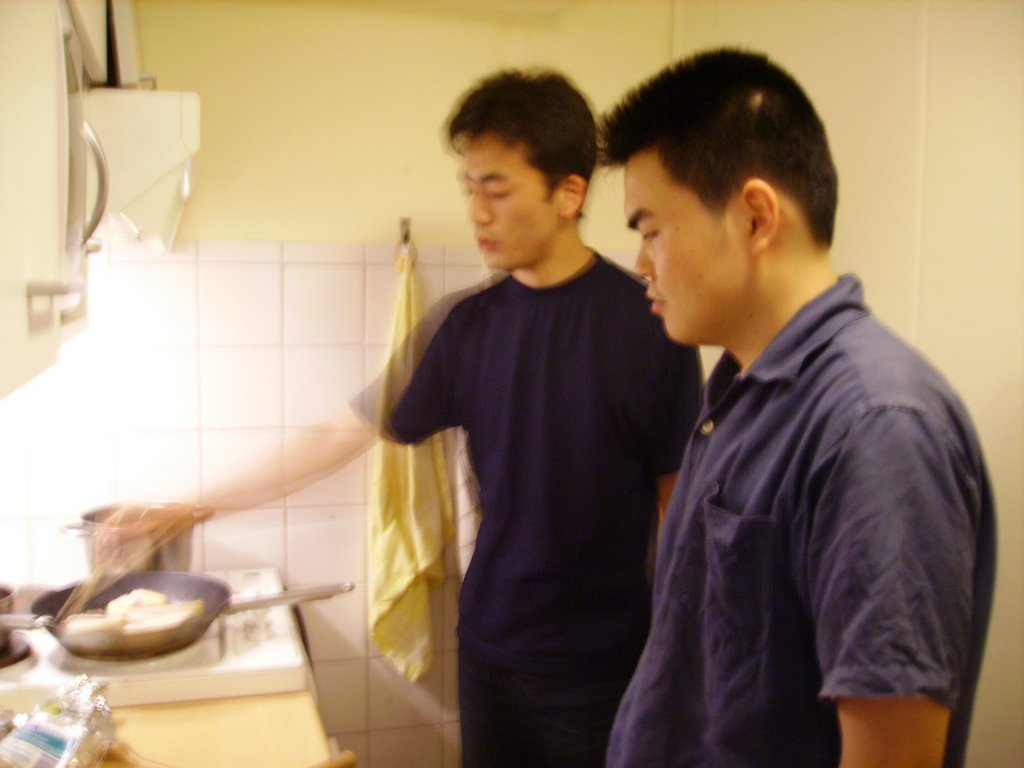
This evening makes me realize how important soy is for Japanese cuisine, and how versatile it is. At left, you see Yusuke happily showing off a pot of miso, the salty fermented soy paste used to add taste to our mackerel.
As we enjoy the swordfish and mackerel skillfully prepared by the two friends, we chat about Yusuke's first impressions of Holland. It turns out he first came here on holiday, to participate in "orienteering camps". He shows a map with little numbers on it and explains that the object is to find all the posts as quickly as possible with just the map and the compass. Quite popular in Holland and Sweden,
 but I'd never heard of it! He is teaching me stuff about my own country...
When he really came to live here he started noticing curiosities as girl lying in the city parks in their bikinis and wearing such tight pants their waists bulge out on top. Hmmm.
Also, he changes my impression of Japanese as little worker bees, by mentioning they often go out for drinks after work as well as going on many organized trips, e.g. to view the cherry blossoms in spring. Sounds a lot more relaxed than I had imagined.
I am also becoming quite relaxed, maybe because I am drinking the sake like water....somehow it doesn't taste that alcoholic! Yusuke tells me it is good sake he brought from Japan, called something that roughly translates into "White Dragon Like Water". The fact that I don't taste the alcohol is a sign of its pureness.
We finish the delicious meal with a special treat: green tea with floating in the murky water...little gold flakes! It doesn't affect the taste, but it sure looks cool.
Click here if you'd like to make Teriyaki Swordfish or Ginger Mackerel yourself, but be sure to stock up on soy sauce and sake!


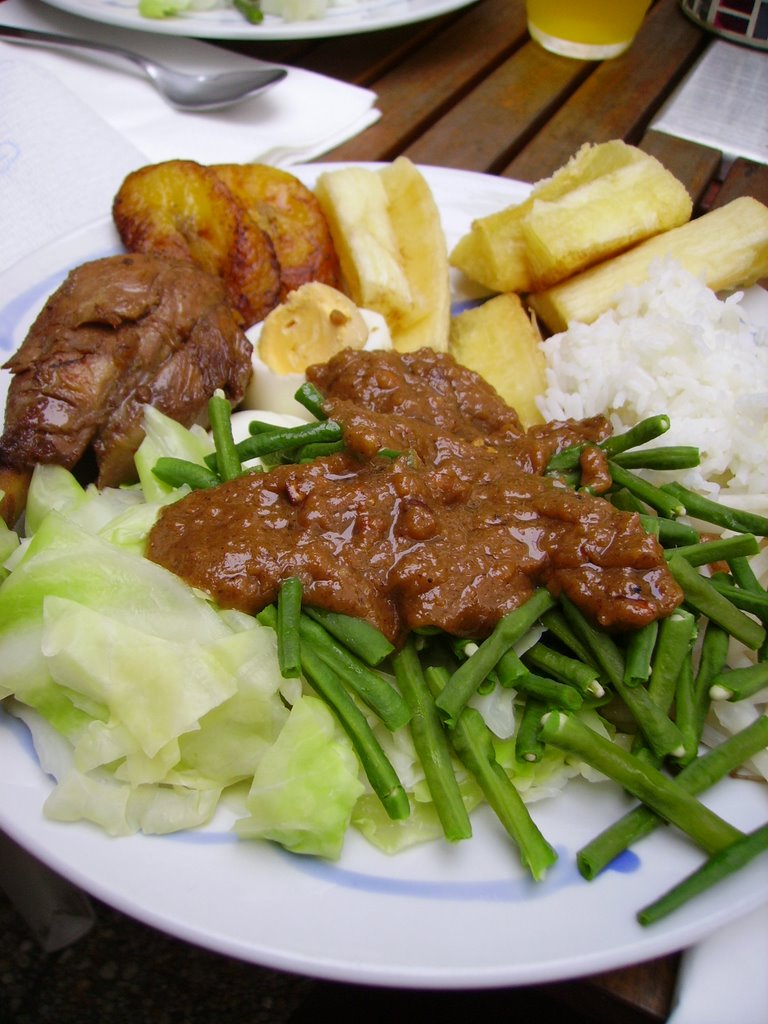
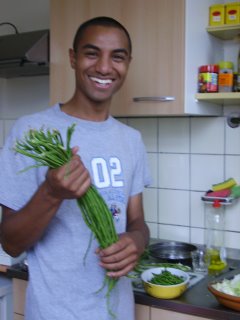 Tonight a Surinamese meal with reknowned cook Martin and his girlfriend Liza, in their sunny garden terrace. Martin tells me he could have made many different dishes: Surinam has as many cuisines as it has ethnic groups. His own roots seem to cover the whole spectrum...he's part Chinese, Indian, Creole and Javanese. His great-aunt ("Oma Tjoekop") provided the "Indonesian" part of this meal: the peanut sauce. Though she still lives in Surinam, she is Martin's source of the dried concentrate he needs to make the spicy sauce. "I wouldn't dare prepare this dish without it!" he confesses.

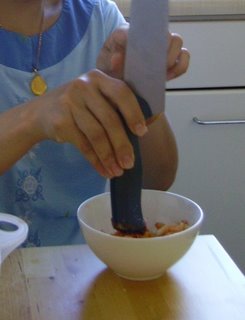 An has lived in the Netherlands for three years now, and has already developed a taste for zuurkool, otherwise known as sauerkraut. She likes to add sugar, thus creating a nice sweet and sour taste. An:"My parents are from the North of Vietnam, and that is where I grew up. In the North, we prefer our food to be quite simple. The predominant taste is salty. I have lived in the South too, where they like sweet dishes. And my husband is from the centre, where the food is spicy!"