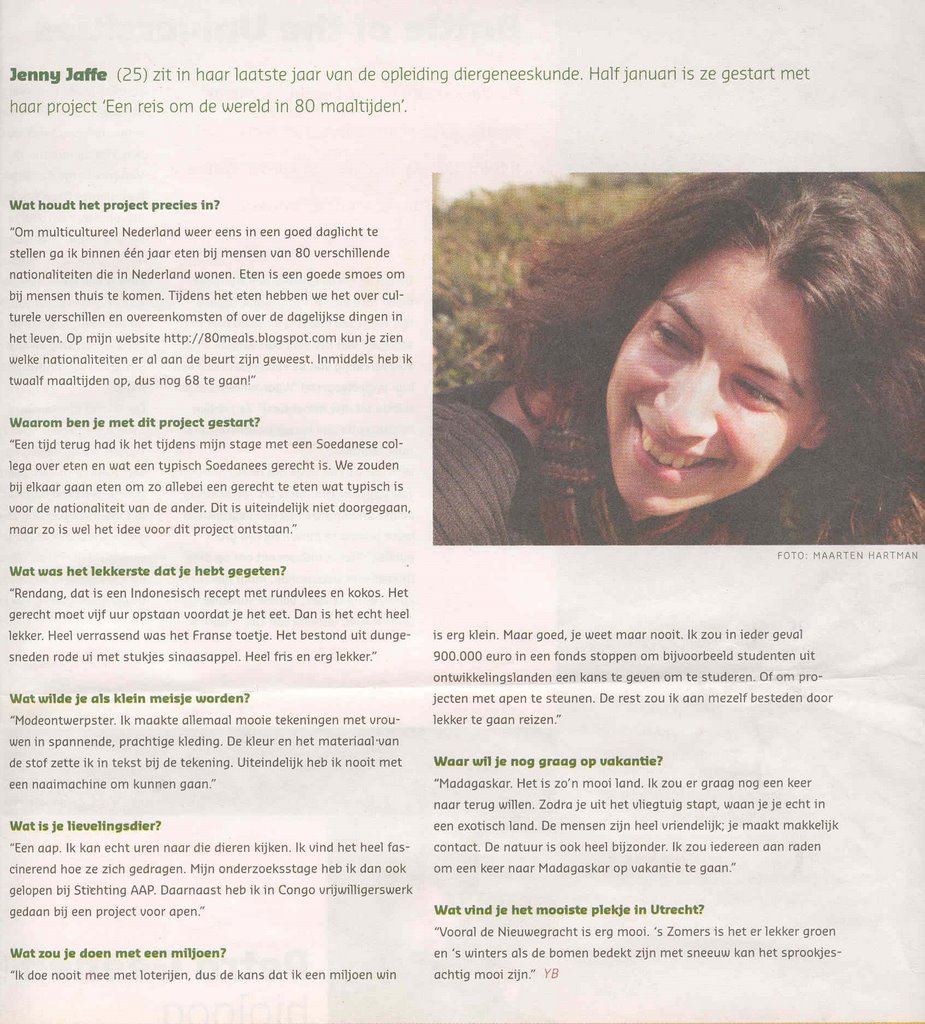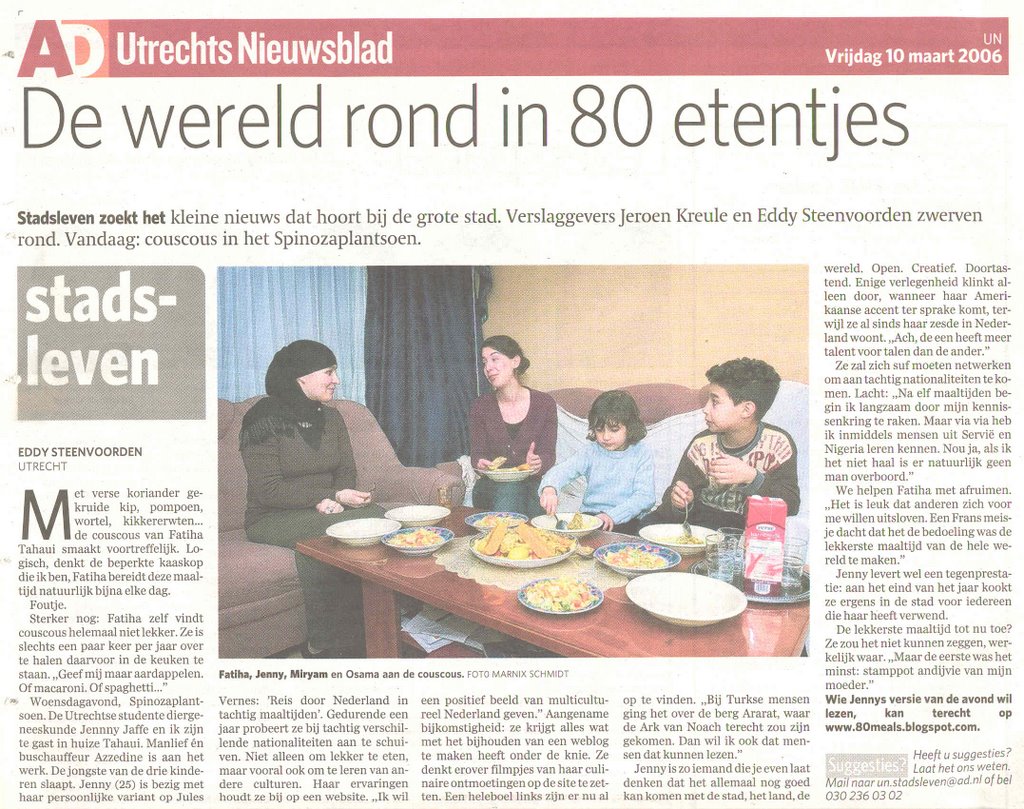
Wednesday, November 22, 2006

Meal 36. Slovenian Jota and Štrudel

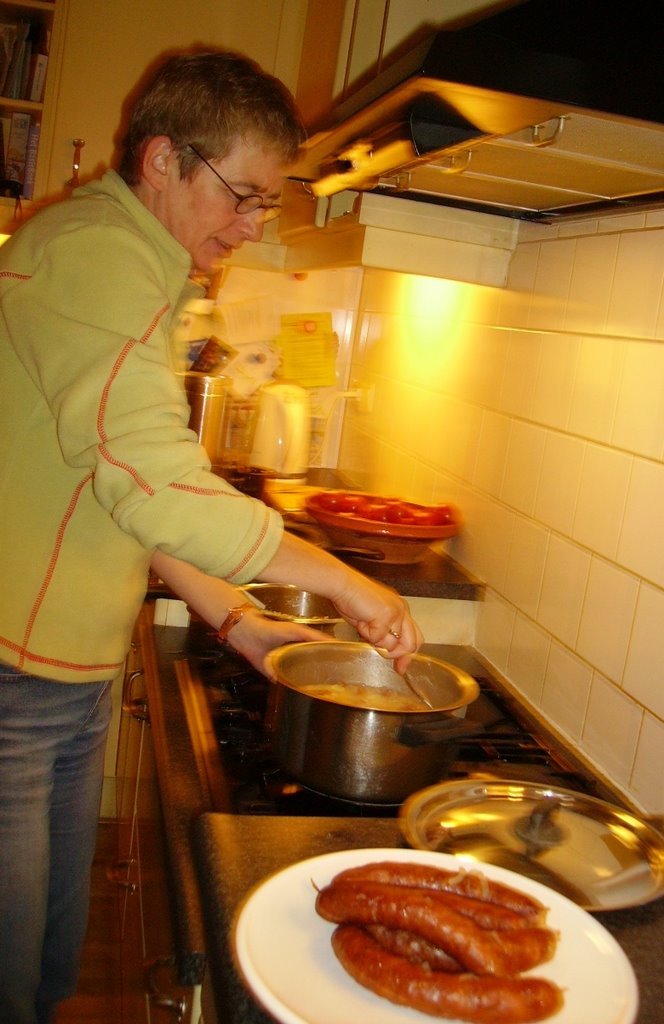
In many cases, "love" is the reason my hosts end up in the Netherlands. For Breda, from Slovenia, it took the shape of Bert. A real Groninger, he came to Slovenia as a surveyor 30 years ago (a project involving gas pipelines) and brought Breda back home with him. They now have two grown daughters who speak both Dutch and Slovenian. The long trip by car to Slovenia has been made dozens of times, and they now divide their time between a small village in Groningen and Breda's birthplace back home. I am proudly shown photos of their new "summer home" and of the house Breda grew up in.......a centuries old fort with walls almost 2 meters thick! With walls that thick, they just built the toilet in the wall.

Even so, it could be quite cold in the winter. It was Breda's father's job to get the fire started in the morning. To get warm enough for this task, a stiff drink was needed first! This practice was shared by many businessmen, who would start the day with a nice coffee and cognac at the local café.

The hearty meal Breda is serving tonight is also meant for cold winter nights. We start off with roasted chestnuts from a tree they've planted themselves in the garden. The main dish, Jota, is traditionally served in mountain huts after a long day's work. It consists of some kind of pickled turnip -Kisla Repa-, sausage (both specially brought over from Slovenia), potatoes, brown beans and lard with bacon. Breda's oldest daughter was vegetarian for a long time, but would make an exception for the bacon bits!
Breda's son-in-law, Erik, tells a story about less delicious food. When he helped out at a farm a couple of years back, the vegetables they got for lunch were from jars of preserves from the cellar. They seemed quite old, and the farmer's widow they worked for would scrape off the layer of mold on top before serving the contents. After she died, it turned out there were preserves in the cellar from before World War II!
The positive side is that you can eat 60 year old food without even becoming sick. But Erik says he never really enjoyed those lunches...
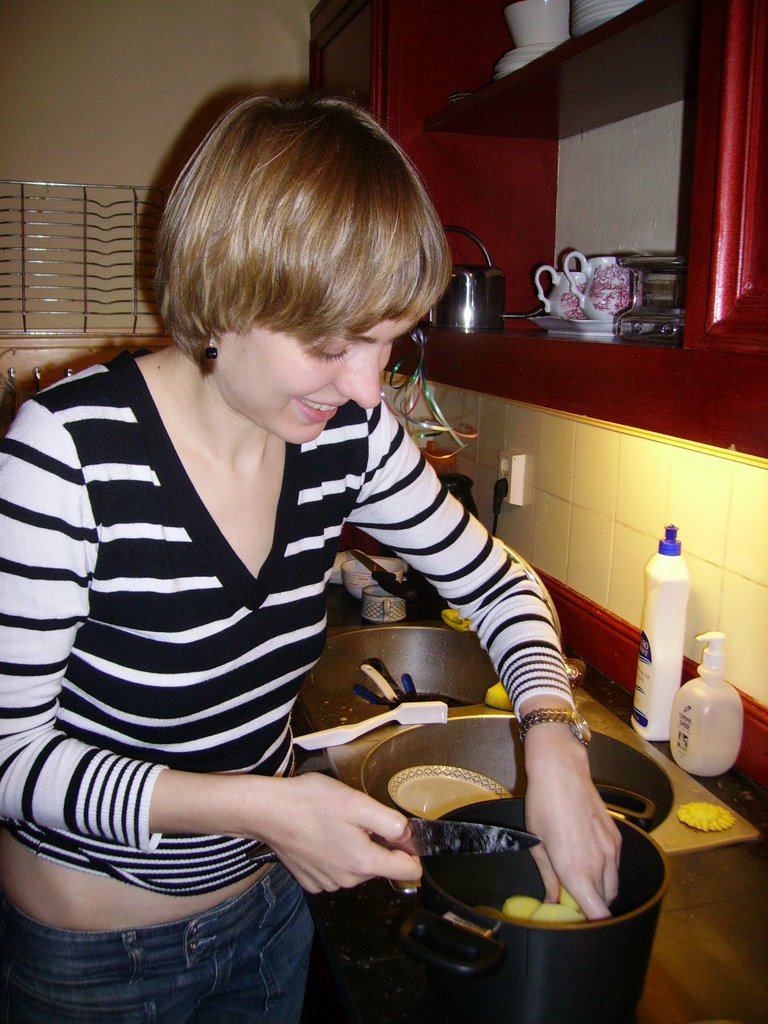
The high point of this meal is the apple strudel for dessert. I enjoy watching the preparations almost as much as eating the hot delicacy, sprinkled with powdered sugar. Nowadays, Breda only makes this apple pastry about twice a year, so it is really a special occasion. Although it isn't difficult to make, it does require several steps and a big table, so I don't see myself doing it anytime soon in my cramped student quarters.
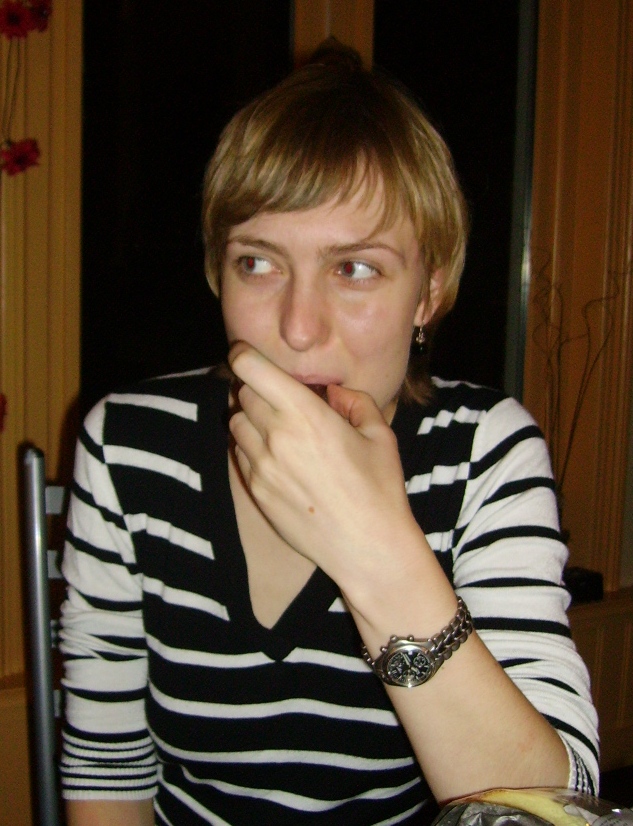
After strudel with cappuccino (Slovenia is close to Italy, after all), I receive a Slovenian going away present made by Breda's sister. It's a jar of plum preserves smelling very strongly of rum. I've tried it already and it's great with custard.
Although Breda loves good food, miraculously she still fits in her 30 year old wedding dress and the stylish velvet jacket she is wearing to a party after dinner. Breda and Bert drop me off at the train station on the way to the party and I am left in the cold with a warm feeling inside, contemplating how generous and hospitable people can be to previously unknown guests like me...
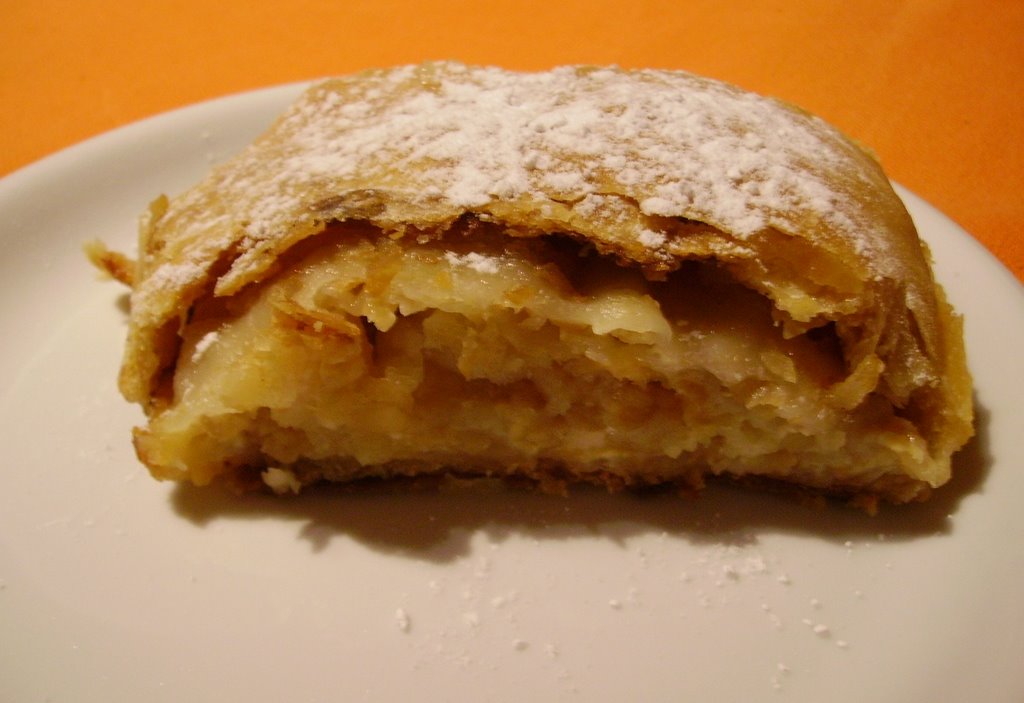


If you have the time, a big table and an old table cloth, you can try Breda's Štrudel recipe at home.

Saturday, November 11, 2006

Meal 35. Lithuanian Barščiai and Potatoes with Dill

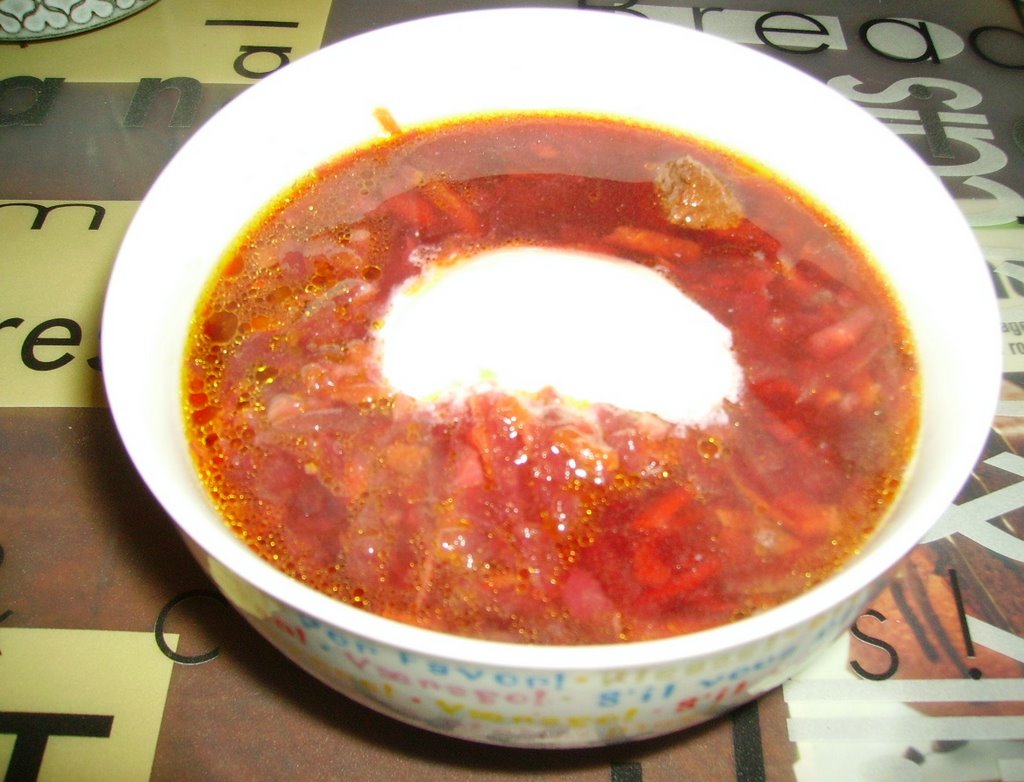
It's the first time I eat barščiai for this project, but not the first time I eat "borsht", an easier way to spell it in English. As you can see in meal 11, where it al revolves around my father's beetsoup.
Gintare (which means "amber" in Lithuanian) is preparing the soup as her grandmother always did it. This recently graduated sociologist does agree the barščiai she is making is similar to many other beetsoups around the world, though for example in Belarus they would add cabbage.
Secretly I am glad we are not eating another local specialty, smoked pig's ear, which is served as a snack with beer. While Gintare is preparing the potatoes, we sip on tea and gobble up some yummy chocolates she brought from home. She's only really lived in the Netherlands for a short time, but sometimes feels frustrated by the language and the bureaucratic procedures. Recently she was called by a girl, who had found Gintare's name through some list of expat Lithuanians. She called and explained her situation, and Gintare commiserated :"Oh yes, I know how you feel...", but then found out while she had only lived here for 2 months, this girl had lived here for over 3 years!

There aren't that many compatriots in Groningen, though she will also feel immediate bonding with Latvians, who speak almost the same (Baltic) language and have a similar culture.
I ask:"What about Estonians?", also a Baltic state, after all.
"Oh no! They are much more similar to the Finnish...a bit more reserved as well."
Well, that's good to know. I wouldn't be surprised if the Dutch were compared to the Flemish, but I would if they were deemed similar to the Germans.
I will ask the Latvian girl who will be cooking for me in December what her opinion is on the matter...
Vilnius (Lithuania) and Riga (Latvia) are now part of Europe and sadly, both are becoming popular destinations for Brittish "stag parties", involving drunk young lads looking for a cheap alcohol and pretty girls. They don't show too much appreciation for its beautiful baroque city centre.
I hope an advantage of joining the EU is an improvement in dental care. Gintare tells me a story about barbaric practices during her childhood including drilling in teeth without painkillers. She was so scared of the dentist she didn't go for seven whole years. At the end of this period, two weeks of dental work were needed to repair the damage!
The soup is delicious, by the way...Gintare's grandmother would be proud.


The potatoes fried in butter with dill are served on the side and are such an easy and effective side dish, I promise myself to make it one day soon. I have to admit, for the borsht/barščiai I will use my own grandmother's recipe!

For those without these loyalty issues, try the Lithuanian version.

Friday, November 03, 2006

Meal 34. Trinidadian Pelau

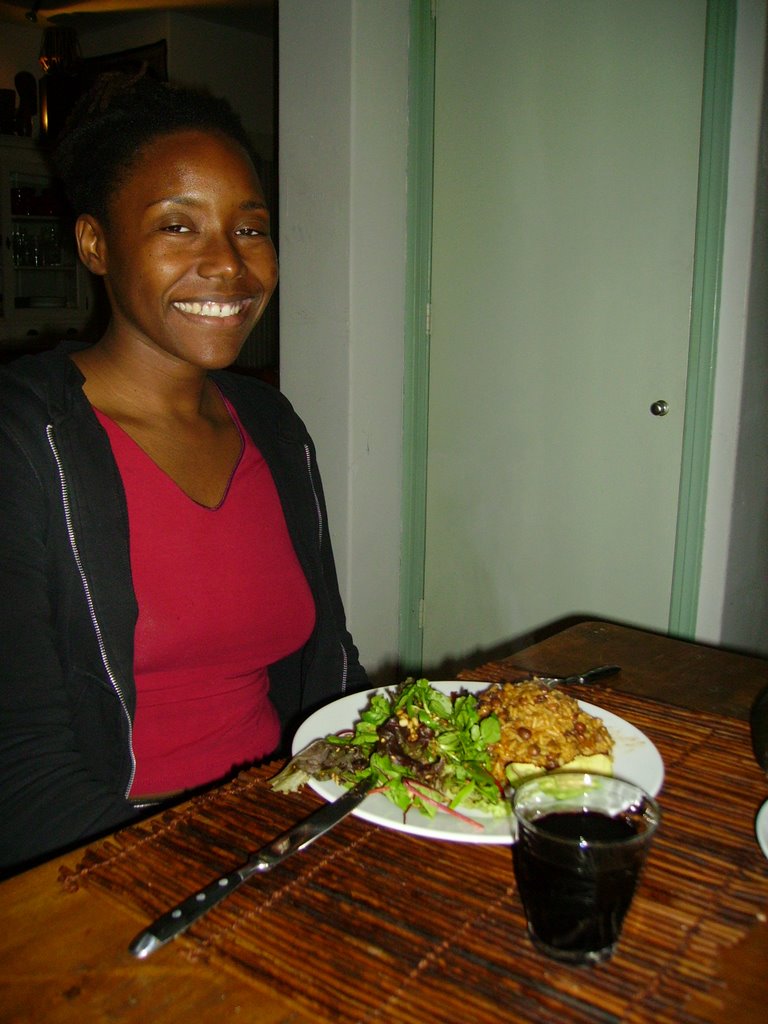
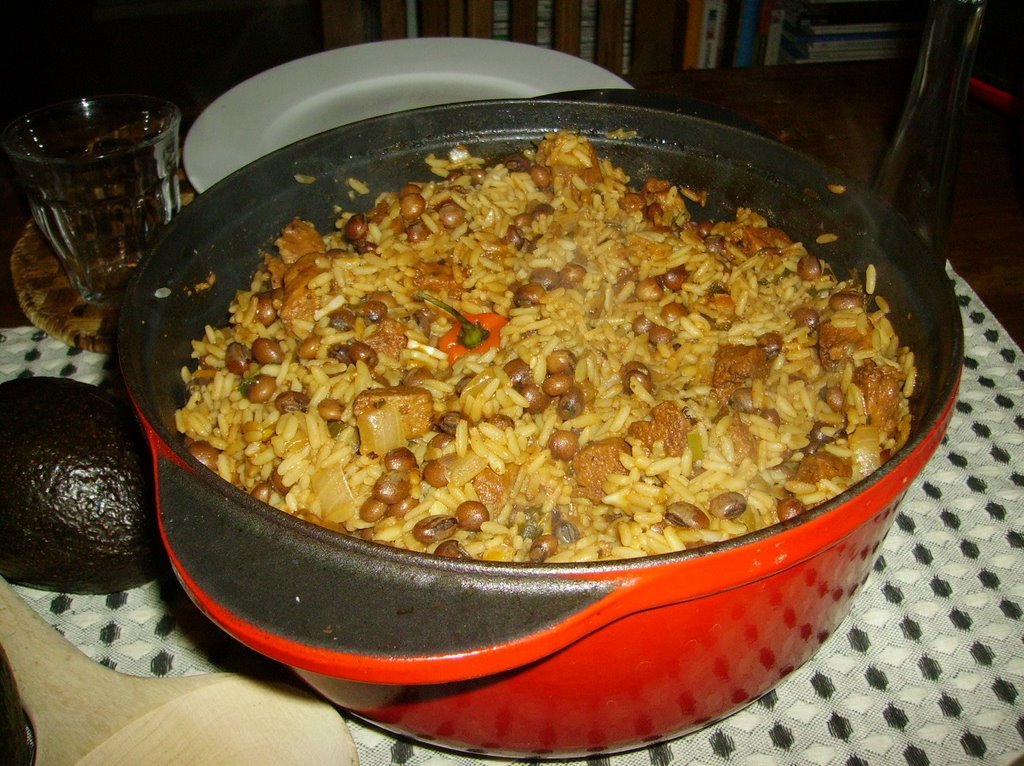
The Trinidadian Pelau Louise is making for me tonight is not 100% typical; the protein component is not the traditional chicken, but vegetarian "Quorn", made from some kind of fungal protein. Sounds a bit weird, but actually tastes good. The pelau is of Indian origin (like half of the inhabitants of Trinidad, including writer V.S.Naipaul), though similar dishes exist - pilau, pilaf, etc. - from many Central Asian and Middle Eastern countries. The Caribbean character of pelau consists of the coconut cream, hot peppers and gungo peas (a bean with a nutty flavour). And the use of caramelized brown sugar.
It reminds me somewhat of the rice 'n peas from my (11th) Jamaican meal.
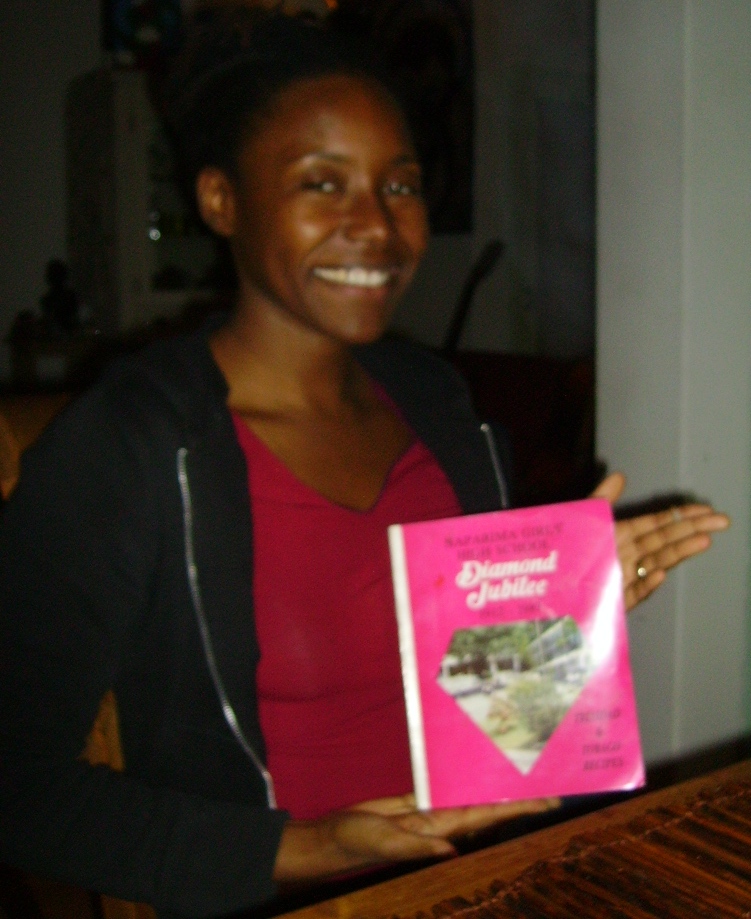
I ask Louise what differences there are between Jamaica (my only reference in the Caribbean) and Trinidad. She mentions the fact that the Jamaican men that came to study at her university were always bowled over by the beauty of the (straight-haired Indo-) Trinidadian girls on campus. Louise herself is "easy on the eyes" with her wide smile and stylish dreadlocks, as her husband Douwe (with even longer dreads) must acknowledge. I would never have guessed she was a petrochemical engineer, a profession I associate with ambitious young men in suits. But then, what do I know? I've never knowingly met one, Louise is the first. For her job, she has to be away for two-week periods every month, now in a small town in Germany, working on pipelines buried beneath the ocean floor. Too much time separated from Douwe! I'm guessing her parents in Trinidad must miss their three children a lot, as they are all living in Europe at the moment.
We relive Trini culture by leafing through an illustrated dictionary that includes such phrases as Fresh Water Yankee. The definition is: "A Trini who goes to America and comes back acting and talking Yankee. Originally someone acting Yankee without even going overseas, or crossing salt water." Thus the fresh water reference.
In an online version I also find: Sucuyant, "A Trini vampire that sheds its human skin and flies at night as a ball of fire, sucking the blood of its victims while they sleep." I wish Louise was here to explain that one for me now!
Less menacing is the word maco, meaning a nosy person or a gossip. It's also the name of one of Louise's favorite glossy magazines, filled with peeks into rich Caribbean people's lives. We admire the photos of a leafy garden of a stylish house in Curaçao and fantasize about what it would be like sitting on the porch at night. Quickly reality sets in when Douwe realizes: "We would be scratching ourselves like crazy because of all the mosquitoes!"
Oh well, maybe in our ideal Caribbean home, we would need to build a screened porch. In chilly Amsterdam, Douwe and Louise do have some impressive tropical plants, among them a Monstera deliciosa with incredibly glossy leaves. Their trick is dusting them with some kind of silicone gloves...

Feel like more domestic tips?


Click here for Louise's instructions for making Trini Pelau. Chicken or Quorn, you decide.

Meal 33. Iranian Khoresht Fesenjan

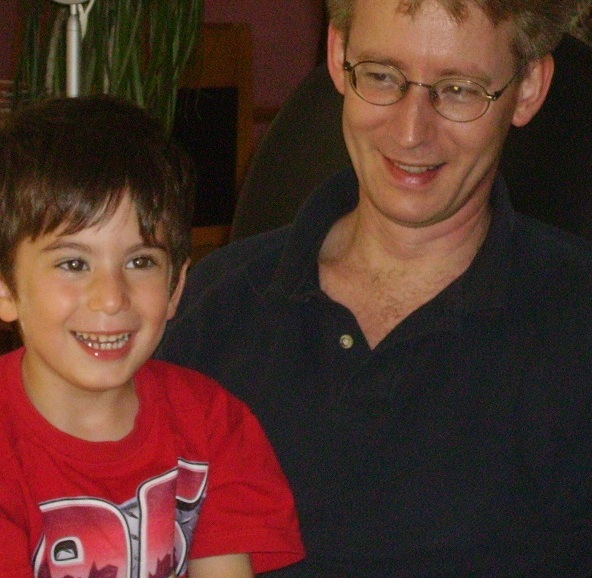
When I meet Vida in person, I am struck by how beautiful and vivacious she is...in our emails beforehand I had just noticed her Dutch was faultless. For this last trait, her husband Eric deserves some of the credit, as he got to know Vida as her tutor of the Dutch language. That he was so eager to teach her voluntarily, might have to do with the first two qualities mentioned!
Together, they have created a very cosy home and two gorgeous and sweet kids, Atousa and Kian. These guys are very happy Vida is making Khoresht Fesenjan tonight, as they love Iranian food, and don't get to eat it all that often. Vida tells me how some of her childhood memories come back when she sees them eat.


They fight over the crisp little potato slices served with the rice, just as Vida and her siblings did way back when.
In general, she finds Iranian food a bit unhealthy, devoid of vegetables, save one exception: the ever-present sabzi (herbs or green vegetables). She has made a beautiful dish of sabzi, with elegantly curled spring onions, and radishes made to look like little flowers. We eat this with feta cheese and thin bread, together this is called Naan-0-Paneer-0-Sabzi. Sounds pretty exotic (and similar to Indian meals with naan and paneer), but it just means "Bread-with-Cheese-with-Herbs".

I am quite amazed by the combination of walnut and pomegranate sauce for the chicken, the Khoresht Fesenjan. The only other nutty sauce I know, is the famous Indonesian peanut sauce (see Meal 31 as well). And I have to admit, I've never made anything with pomegranate. It mostly reminds me of the less innocent grenades, the weapon which is named after this fruit. Vida had a special bottle of Iranian syrup for this recipe, but you can also use pomegranate juice, which is available in most big supermarkets (and which we drink to accompany our meal).
After enjoying our really Iranian food, we are treated to a less typical Toblerone chocolate fondue. Yummy! If you understand Farsi, you can read about it on Vida's own blog.
And to top it all off, our after dinner entertainment is provided by Kian playing the keyboard and Atousa giving us a little concert with her recorder. So sweet...


If you'd like to try the walnut&pomegranate sauce or the bread-with-cheese-with-herbs, click here to view the recipes:

Khoresht Fesenjan
Naan-o-Paneer-o-Sabzi

Tuesday, October 31, 2006

Meal 32. Japanese Teriyaki Swordfish and Ginger Mackerel

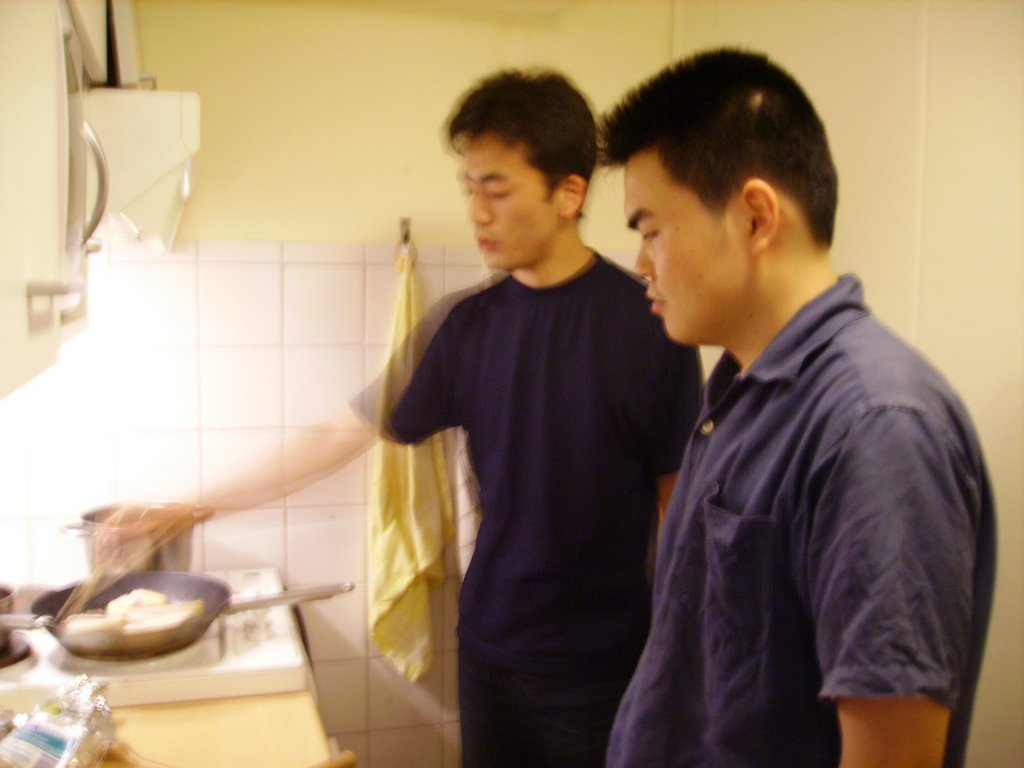
Yusuke is our cook tonight, together with his good friend and fellow biologist, Nobuto. It seems much preliminary effort has gone into the meal, with Yusuke having bought ingredients on a recent trip to Japan and in a specialized store in Amsterdam.
Everything is served in pretty little dishes, very pleasing to the eye. Which confirms my stereotype of the Japanese as "lovers of beauty".
We start out with some eda-mame...these green soy beans, simply boiled in salt water, are great as a snack with a beer! They have a slightly nutty flavour and it is fun to pop them open in my mouth.
Then Yusuke makes me try an innocent looking pickled plum...it is a taste explosion! They are incredibly salty - so much so that Yusuke claims one ume-boshi is enough to flavour a whole bowl of boiled rice. This meal is called the "Japanese flag", as the round plum in the middle of the rice resembles the red circle on a white backround.
Afterwards, we are served spinach, prepared with soy sauce and sesame seeds, and eaten with chopsticks of course. As well as matchsticks of yama-imo, "mountain potato", a white sticky root flavoured with fish flakes and (again!) soy sauce.
This evening makes me realize how important soy is for Japanese cuisine, and how versatile it is. At left, you see Yusuke happily showing off a pot of miso, the salty fermented soy paste used to add taste to our mackerel.


As we enjoy the swordfish and mackerel skillfully prepared by the two friends, we chat about Yusuke's first impressions of Holland. It turns out he first came here on holiday, to participate in "orienteering camps". He shows a map with little numbers on it and explains that the object is to find all the posts as quickly as possible with just the map and the compass. Quite popular in Holland and Sweden, but I'd never heard of it! He is teaching me stuff about my own country...
When he really came to live here he started noticing curiosities as girl lying in the city parks in their bikinis and wearing such tight pants their waists bulge out on top. Hmmm.
Also, he changes my impression of Japanese as little worker bees, by mentioning they often go out for drinks after work as well as going on many organized trips, e.g. to view the cherry blossoms in spring. Sounds a lot more relaxed than I had imagined.
I am also becoming quite relaxed, maybe because I am drinking the sake like water....somehow it doesn't taste that alcoholic! Yusuke tells me it is good sake he brought from Japan, called something that roughly translates into "White Dragon Like Water". The fact that I don't taste the alcohol is a sign of its pureness.
We finish the delicious meal with a special treat: green tea with floating in the murky water...little gold flakes! It doesn't affect the taste, but it sure looks cool.


Click here if you'd like to make Teriyaki Swordfish or Ginger Mackerel yourself, but be sure to stock up on soy sauce and sake!