Tuesday, October 31, 2006

Meal 32. Japanese Teriyaki Swordfish and Ginger Mackerel

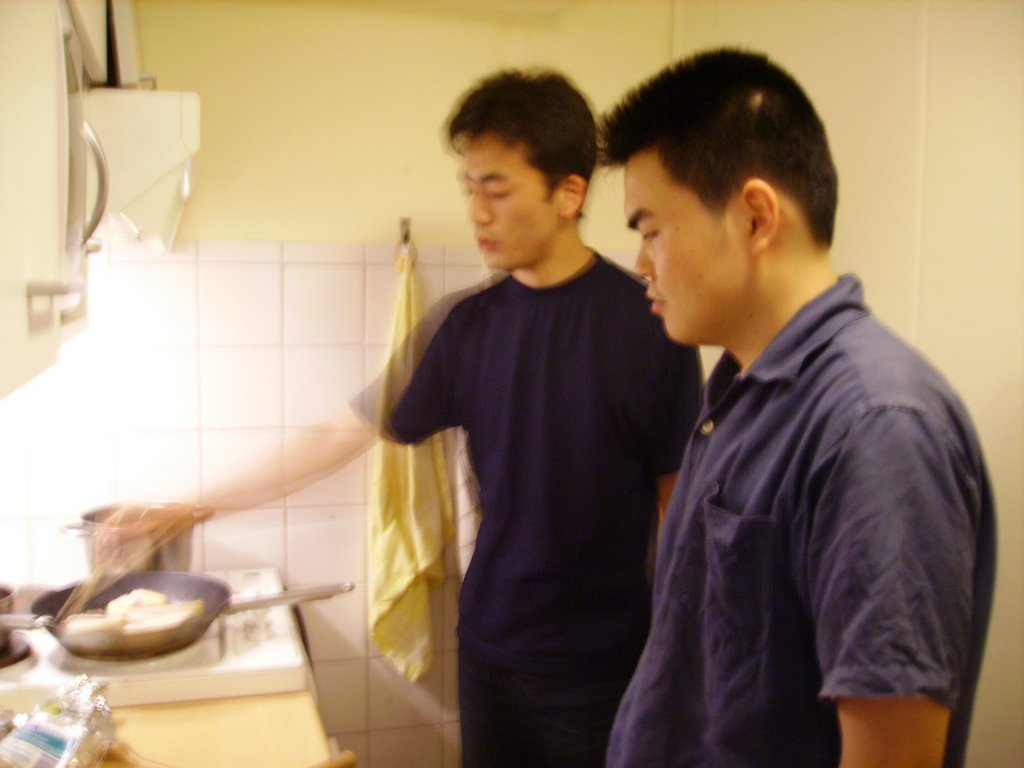
Yusuke is our cook tonight, together with his good friend and fellow biologist, Nobuto. It seems much preliminary effort has gone into the meal, with Yusuke having bought ingredients on a recent trip to Japan and in a specialized store in Amsterdam.
Everything is served in pretty little dishes, very pleasing to the eye. Which confirms my stereotype of the Japanese as "lovers of beauty".
We start out with some eda-mame...these green soy beans, simply boiled in salt water, are great as a snack with a beer! They have a slightly nutty flavour and it is fun to pop them open in my mouth.
Then Yusuke makes me try an innocent looking pickled plum...it is a taste explosion! They are incredibly salty - so much so that Yusuke claims one ume-boshi is enough to flavour a whole bowl of boiled rice. This meal is called the "Japanese flag", as the round plum in the middle of the rice resembles the red circle on a white backround.
Afterwards, we are served spinach, prepared with soy sauce and sesame seeds, and eaten with chopsticks of course. As well as matchsticks of yama-imo, "mountain potato", a white sticky root flavoured with fish flakes and (again!) soy sauce.
This evening makes me realize how important soy is for Japanese cuisine, and how versatile it is. At left, you see Yusuke happily showing off a pot of miso, the salty fermented soy paste used to add taste to our mackerel.


As we enjoy the swordfish and mackerel skillfully prepared by the two friends, we chat about Yusuke's first impressions of Holland. It turns out he first came here on holiday, to participate in "orienteering camps". He shows a map with little numbers on it and explains that the object is to find all the posts as quickly as possible with just the map and the compass. Quite popular in Holland and Sweden, but I'd never heard of it! He is teaching me stuff about my own country...
When he really came to live here he started noticing curiosities as girl lying in the city parks in their bikinis and wearing such tight pants their waists bulge out on top. Hmmm.
Also, he changes my impression of Japanese as little worker bees, by mentioning they often go out for drinks after work as well as going on many organized trips, e.g. to view the cherry blossoms in spring. Sounds a lot more relaxed than I had imagined.
I am also becoming quite relaxed, maybe because I am drinking the sake like water....somehow it doesn't taste that alcoholic! Yusuke tells me it is good sake he brought from Japan, called something that roughly translates into "White Dragon Like Water". The fact that I don't taste the alcohol is a sign of its pureness.
We finish the delicious meal with a special treat: green tea with floating in the murky water...little gold flakes! It doesn't affect the taste, but it sure looks cool.


Click here if you'd like to make Teriyaki Swordfish or Ginger Mackerel yourself, but be sure to stock up on soy sauce and sake!

Tuesday, September 19, 2006

Meal 31. Surinamese Pitjel, Telo and Chicken

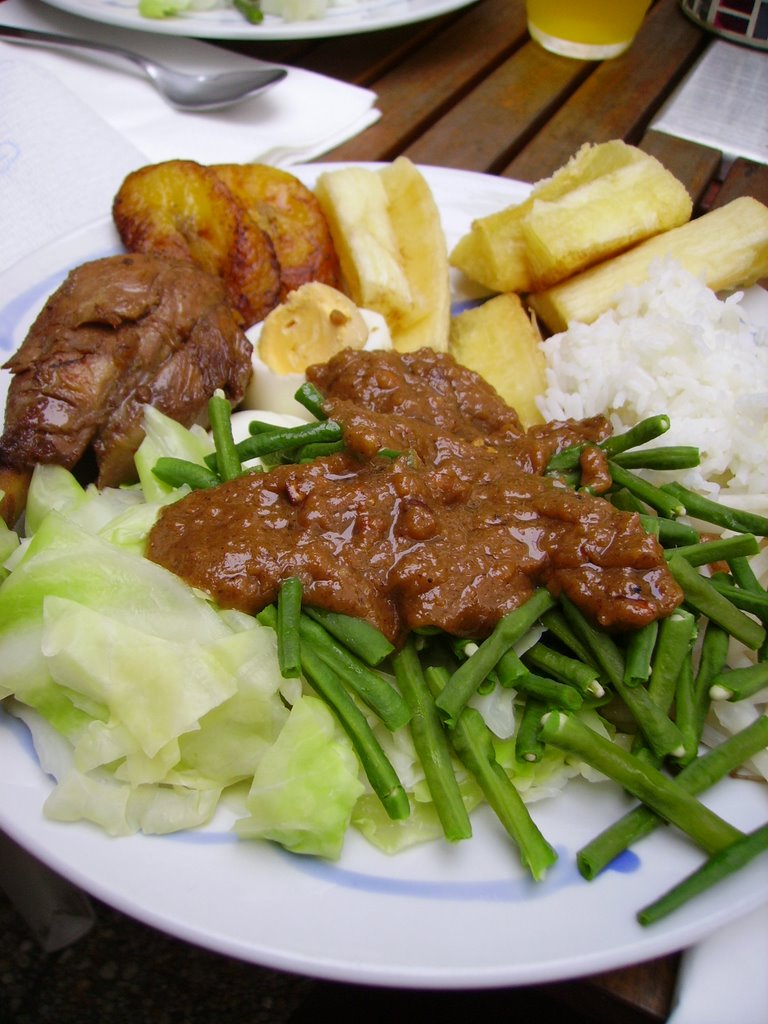
Tonight a Surinamese meal with reknowned cook Martin and his girlfriend Liza, in their sunny garden terrace. Martin tells me he could have made many different dishes: Surinam has as many cuisines as it has ethnic groups. His own roots seem to cover the whole spectrum...he's part Chinese, Indian, Creole and Javanese. His great-aunt ("Oma Tjoekop") provided the "Indonesian" part of this meal: the peanut sauce. Though she still lives in Surinam, she is Martin's source of the dried concentrate he needs to make the spicy sauce. "I wouldn't dare prepare this dish without it!" he confesses.
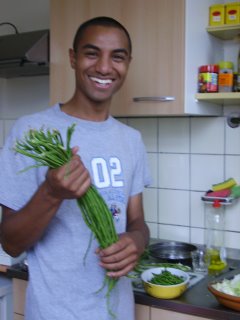
At right, you can see how happy he is with the famous "garterbelt" beans (kouseband), a Surinamese staple ingredient.
Other favorites included in tonight's meal are fried cassava (telo, at left) and fried plantain.
To accompany the food we drink Heineken and Fernandes soft drinks. This local brand started out with "Fernandes Red" and "Fernandes Green", and when those proved immensely popular, expanded its "exotic drinks" imperium with "Blue" and "Yellow". I find it amusing that nobody ever refers to what fruit the drinks are supposed to taste like. (I think the inspiration for Green is apples).
The pitjel is an assembled dish of loose elements that work well together. If we're being poetic, we could say the same about Surinam, a country where people of distinct cultures live together harmoniously.
While enjoying the pitjel with two of Martin's colleagues (from the Netherlands Basketball Federation), we discuss the Surinamese habit of making tjoeries (CHOO-rees). This sign of disapproval consists of pursing the lips and sucking in air as loudly as possible. The lips should be sucked against the teeth, else it doesn't work...
The tjoerie has even been mentioned as early as 1933 in the correspondence of a Dutch missionary to Surinam! Martin and Liza mention that when Surinamese men make flattering remarks to women on the street, the object of their affection will never respond. Only if the remark is highly amusing, will she deign to react...by making a tjoerie. (Warning: Never do this to your parents! It is highly disrespectful! )

Click here if you'd like to recreate this meal (without Oma Tjoekop....)
Peanut sauce
Telo, deep fried cassava
Pitjel, assembled dish

Tuesday, July 25, 2006

Meal 30. Vietnamese Bò Bóp Thâú (Beef Salad)

An has lived in the Netherlands for three years now, and has already developed a taste for zuurkool, otherwise known as sauerkraut. She likes to add sugar, thus creating a nice sweet and sour taste. An:"My parents are from the North of Vietnam, and that is where I grew up. In the North, we prefer our food to be quite simple. The predominant taste is salty. I have lived in the South too, where they like sweet dishes. And my husband is from the centre, where the food is spicy!"
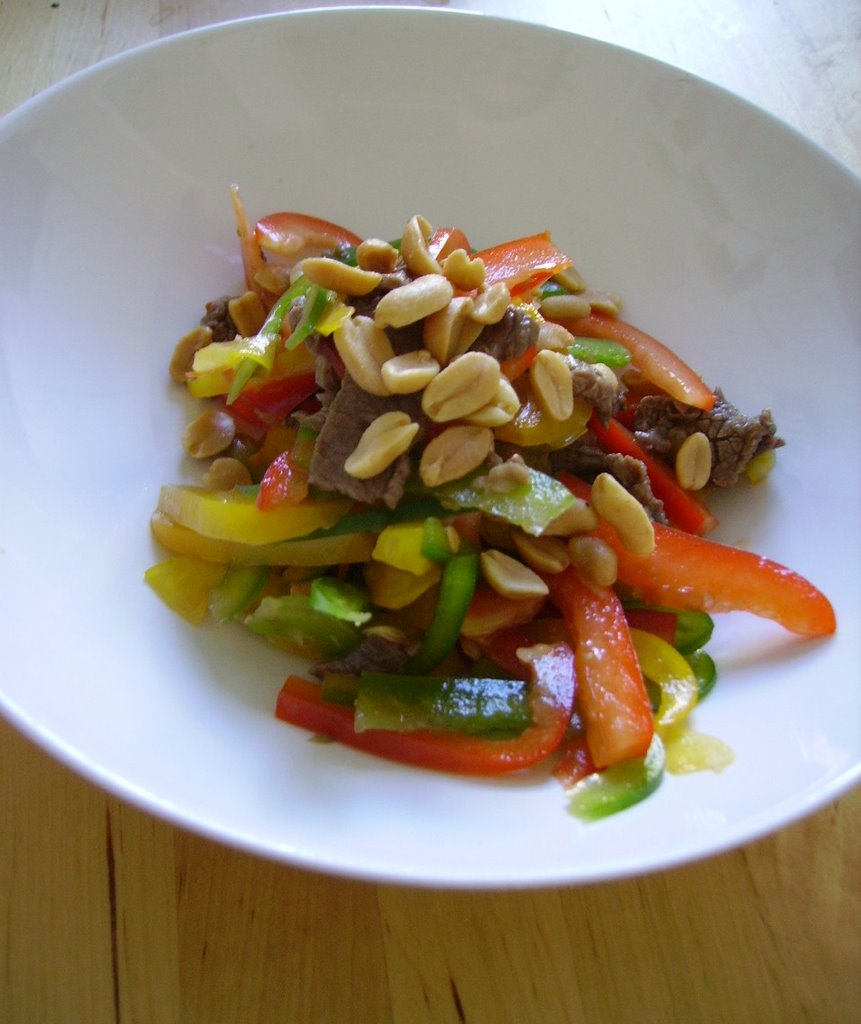
Today, the dish is both spicy and a bit sweet. The beef salad, Bò Bóp Thâú, is perfect summer food. The marinated and fried strips of beef are added to a colourful mix of thinly sliced bell peppers.
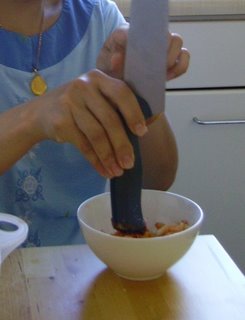
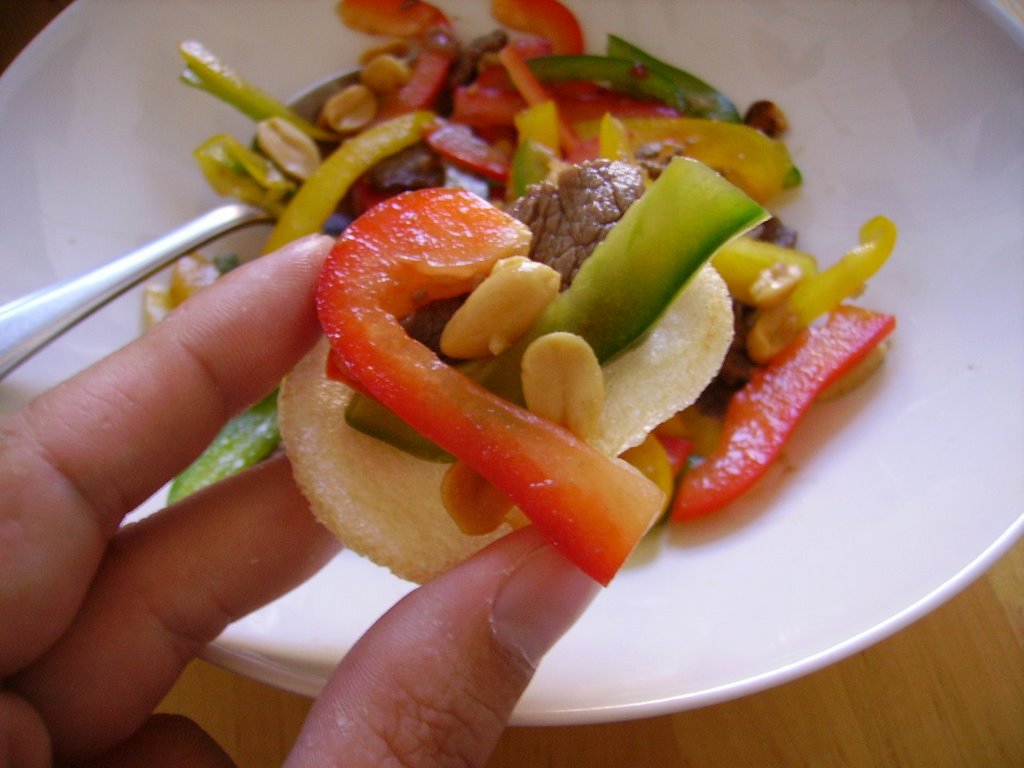
It's funny to see how An crushes the garlic with the butt of a big knife, instead of with a garlic press. The technique reminds me of the mortar and pestle they use in Indonesia (and elsewhere) to make sambal. The salad itself is eaten by heaping a bit of it on a pieace of krupuk (shrimp cracker) and popping that in your mouth.
In Vietnam An teaches at the university, and now she is doing her Ph.D. here, to gain practical experience for the lab that has just been built back home. The Ph.D. is being paid for by Vietnam and hopefully will guarantee more job stability in the future. I am impressed by the big sacrifice she is making by leaving her husband and young daughter behind...she only gets to see them once a year.
Yes, An says, Vietnam is still a poor country, but things are changing. The last 15 years or so, the country has modernized a bit, becoming more democratic and more open to foreign investments. Why do foreign companies like Vietnam? An: "Well, my guess is it's because the Vietnamese work very hard, are friendly and don't complain!"
"A good thing is that the Vietnamese do not only do the low level work. There is a construction that involves companies employing locals in management positions as well. After five to ten years, only the chief manager is foreign, and after twenty years, the company should be completely Vietnamese!"
If this really works out that way, it does seem like a good development. An's daughter will probably grow up in a very different Vietnam.

Click here for the "French inspired" recipe for beef salad: Vietnamese Bò Bóp Thâú

Thursday, July 20, 2006

Meal 29. Chinese Stir fried Chicken with Red Pepper

Mike has been studying Economics in Maastricht for a few years now. His real name is Jin, but to make is easier for us Europeans, he lets us call him Mike. He tells me that at elementary school, all the pupils get to choose an English name.
Though he is a bit shy about having his photo taken, Mike is very open about everything else and answers all my questions about China...even when I want to know about the little kids with a big hole in their pants instead of diapers!
As I help him take the skin off the chicken legs, we talk about his first weeks in the Netherlands. He still was the typical Chinese guy, and even when he arrived at a friend's place dying of thirst, he didn't dare accept the first offer of a drink. In China, you should politely decline the first two times the host offers you something and then accept the third time. But here his friend just accepted the first no and didn't ask again. Leaving poor Mike with a parched mouth...
Also, when he would give people a light, he would expect them to touch his hands in thanks, which is polite in China. But in Holland this is deemed to be slightly too intimate when your cigarette is being lit by a stranger.
During the preparations I am blown away by the 25 kg bag of rice Mike has in the kitchen. This size would be enough to feed a small family for two months...
The rice is cooked in an electric rice cooker he brought over from Shen Yang, his home town. His cool pan (with Chinese symbols on the bottom) and many of the spices were purchased in a Chinese shop here in Holland.
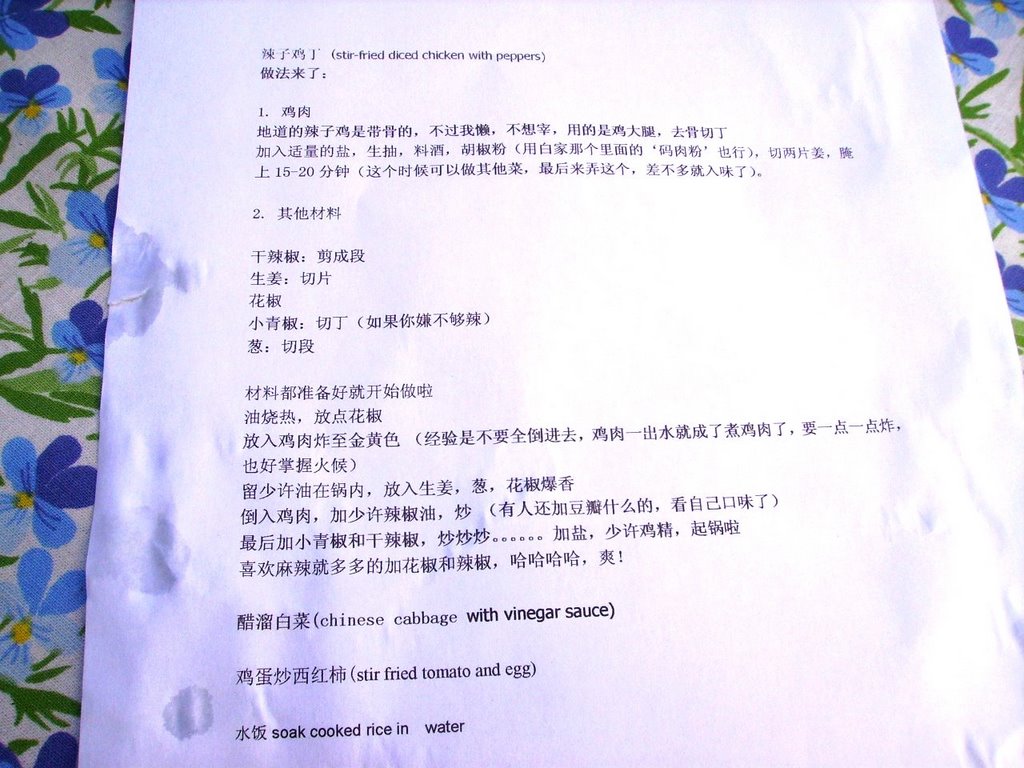
Mike learnt to cook from his grandmother, but only really started practicing after he came here. He tells me less and less young people know how to cook nowadays, partly because they eat out a lot. The meal he is making for me tonight is a "famous meal", and he has downloaded a recipe from internet to be sure he does everything in the right order. The recipe looks very exotic to me!
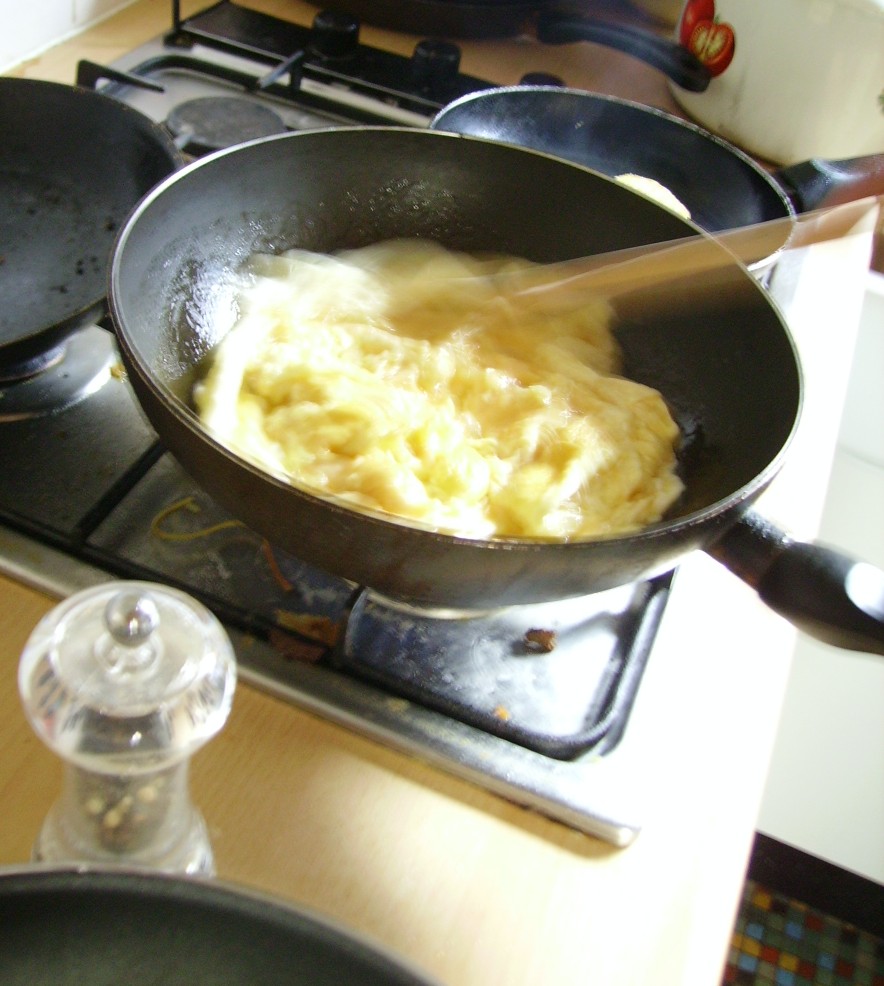
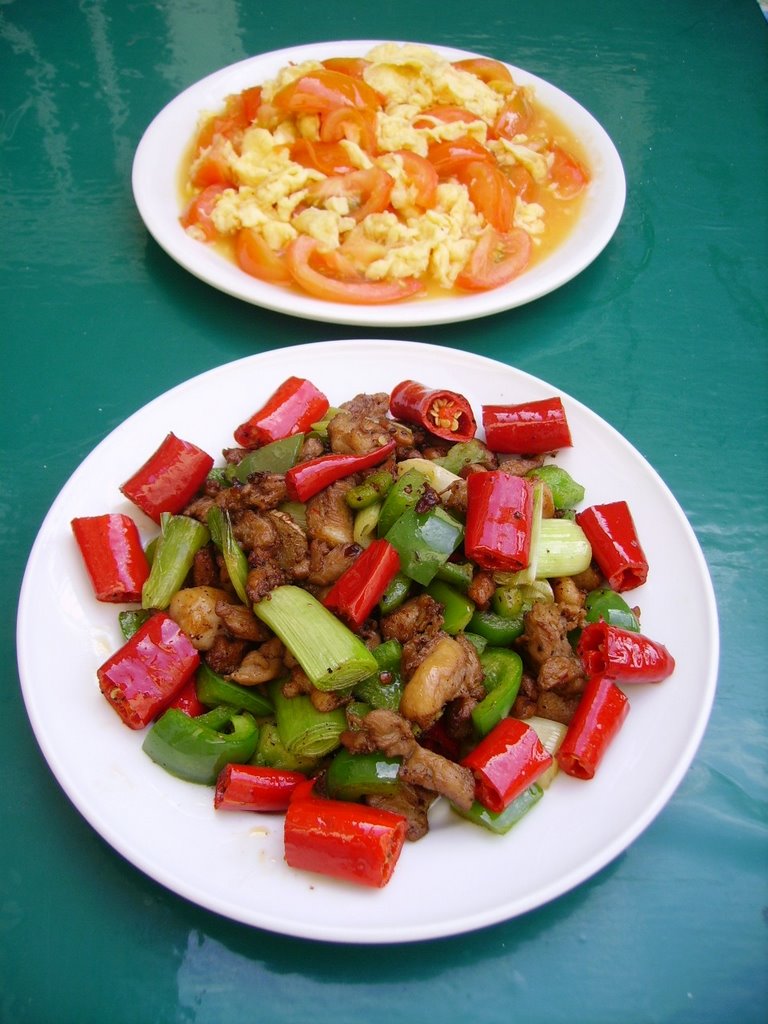
The stir frying is a real show, the hot oil sizzling, especially when the omelet mix is thrown in...an enormous puffy omelet appears in just a few seconds. The omelet with tomato is a big success amongst Mike's European friends, probably because of the secret ingredient...sugar! And maybe because of the mysterious "chicken broth mix" from Knorr that Mike adds to the omelet and the chicken dish. The ingredients list corn starch, salt and monosodium glutamate (the famous flavour enhancer ve-tsin).
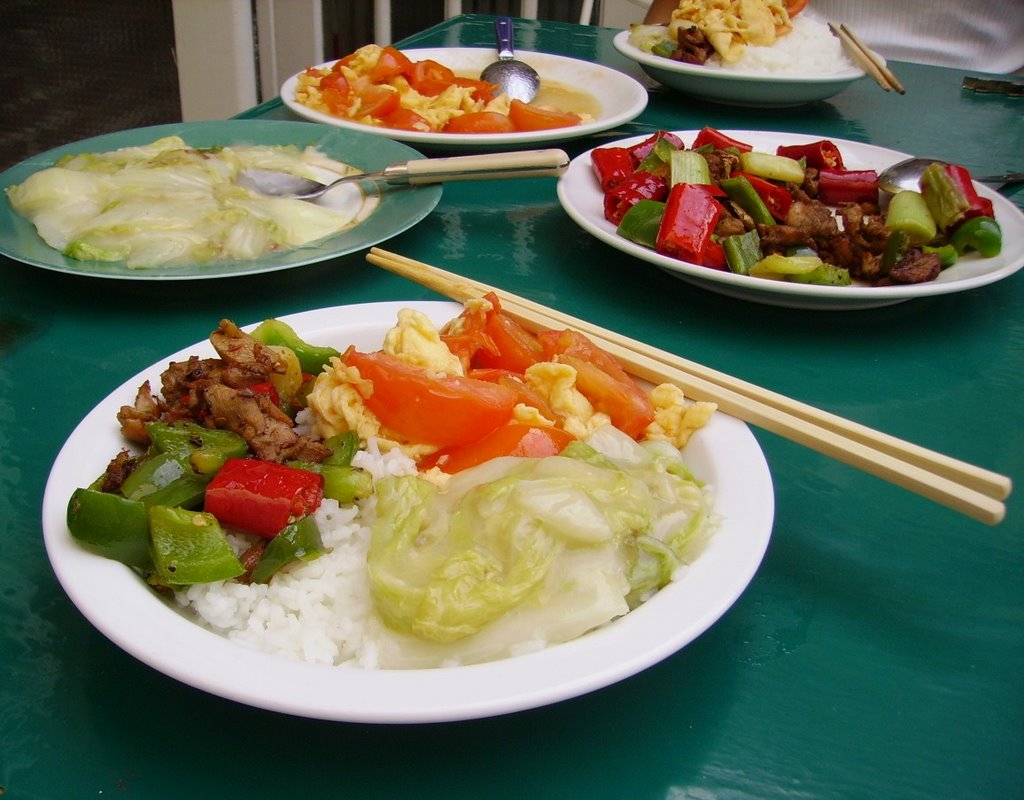
After everything is done I do my best with the chop sticks and enjoy the spicy chicken, chinese cabbage with glutinous vinegar sauce and sweet omelet with tomato. Mike tells me that if we had been in China, as a host he should have been sitting with his back to the door. This unspoken rule of communication also entails that in restaurants the person sitting in that position is the person that pays! Good to know if I ever make it to China...


Click here for the recipes:
Chinese Stir fried Chicken with Red Pepper
Chinese Sweet Omelet with Tomato

Tuesday, July 11, 2006

Meal 28. Romanian Mămăligă cu Brânză

Antoanella and her Dutch boyfriend Herman met while he was on holiday in Romania. Though in the beginning she hardly spoke any English or Dutch nor did he speak any Romanian, by now they've been a couple for many years and live together in Rotterdam. He has learned some Romanian, and Anto's Dutch is good enough to have completed her Master in Physical Geography here. For fun, she's even started on the novels in Herman's alphabetically arranged bookcase. She's already at the end of the B's!
Before dinner, we have wine and some appetizers, including Salată de vinete, aubergine dip with a smoky flavour. Romanian wine is very famous...in Romania. Anto tells about a local wine winning an important medal in Brussels. But when she googled it, the only sites that reported about this prize were Romanian ones.
Besides wine, (home-brewed) strong liquor is a big favourite in Romania. When travelling by bus or train, it's common that people will go round with plastic cups and 2 L coke bottles with some kind of moonshine. Even if it's 10 o'clock in the morning...this makes travelling by public transport quite fun!
Though a Romanian host will unvaryingly offer ample amounts of food and drink to visitors, it wasn't always that easy to come by ingredients. Anto recalls how during the Communist era, Christmas would mean waiting in line for meat for days. Families would queue in shifts so as not to lose their place in line. The best job during those days was in a shop, even a shoestore. That way, you could trade shoes for food.
Anto's grandfather worked at a farm collective, and with six kids it was sometimes hard to feed them all. He was allowed to take home hay, so would sometimes smuggle along little bags with milk hidden amongst the hay.
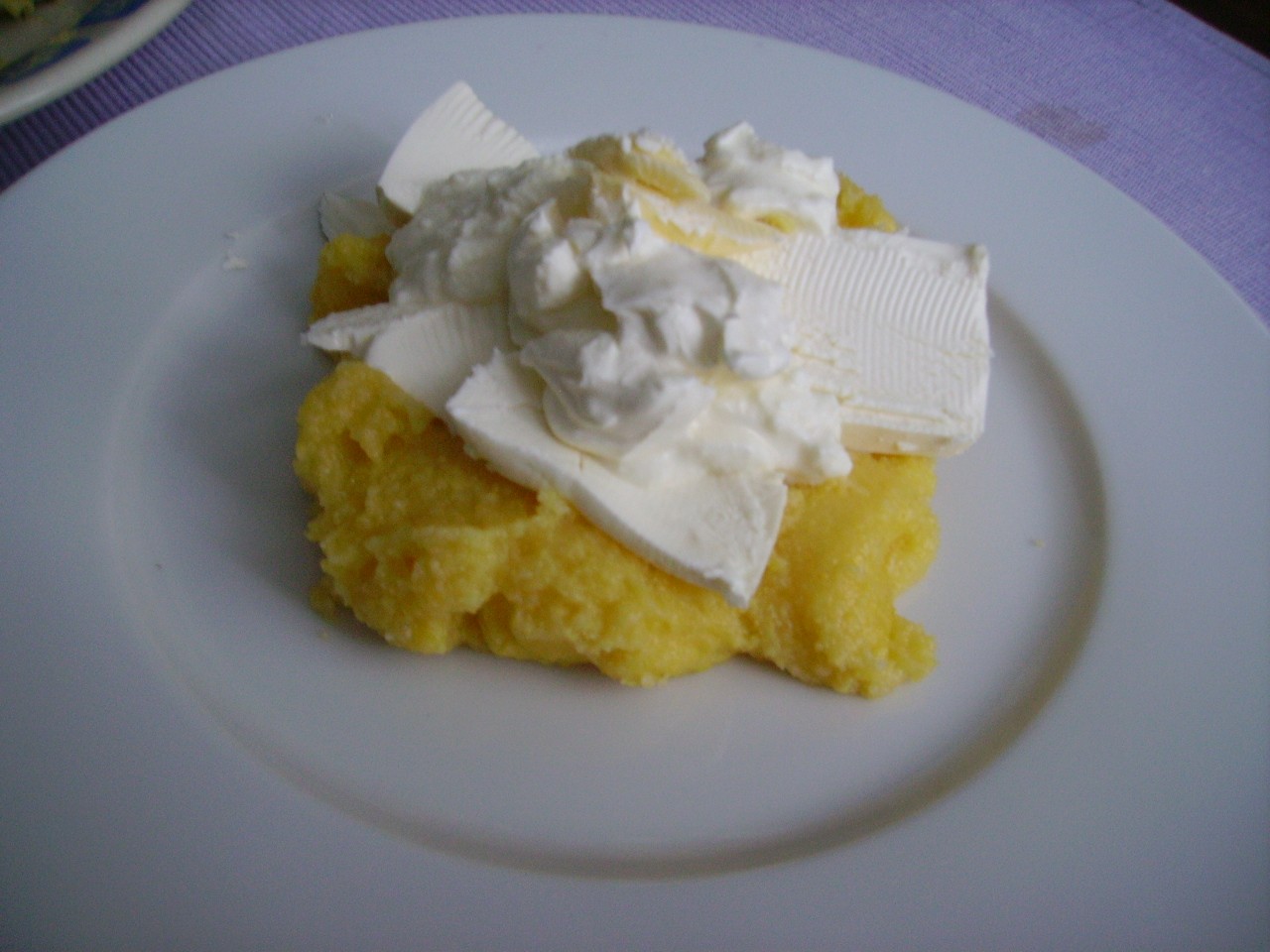
Nowadays, Romania is actually doing pretty well according to Anto, and she doesn't really understand why Dutch people still send trucks full of food, clothing and toys to her country. Many other countries are a lot poorer...but she and Herman think the Dutch that started sending over help after the fall of Communism just enjoy their time in Romania. Nice food and drink, locals happy with the gifts...why change the routine? If the food served there is similar to what Antoanella is serving, I certainly wouldn't! After the appetizers, we start with Mămăligă cu Brânză, a kind of polenta with a choice of butter, yoghurt, sour cream and feta like cheese that can be added to taste. The next course is a delicious stuffed pepper, which should be served with bread. Actually, everything should be served with bread in Romania, even if it's a carb laden dish like lasagna or rice. Bread is also used as a kind of utensil, you eat with a fork in one hand and a piece of bread in your other one, to fold around meat or to soak up the sauce. Spoons and knives are hardly ever used.
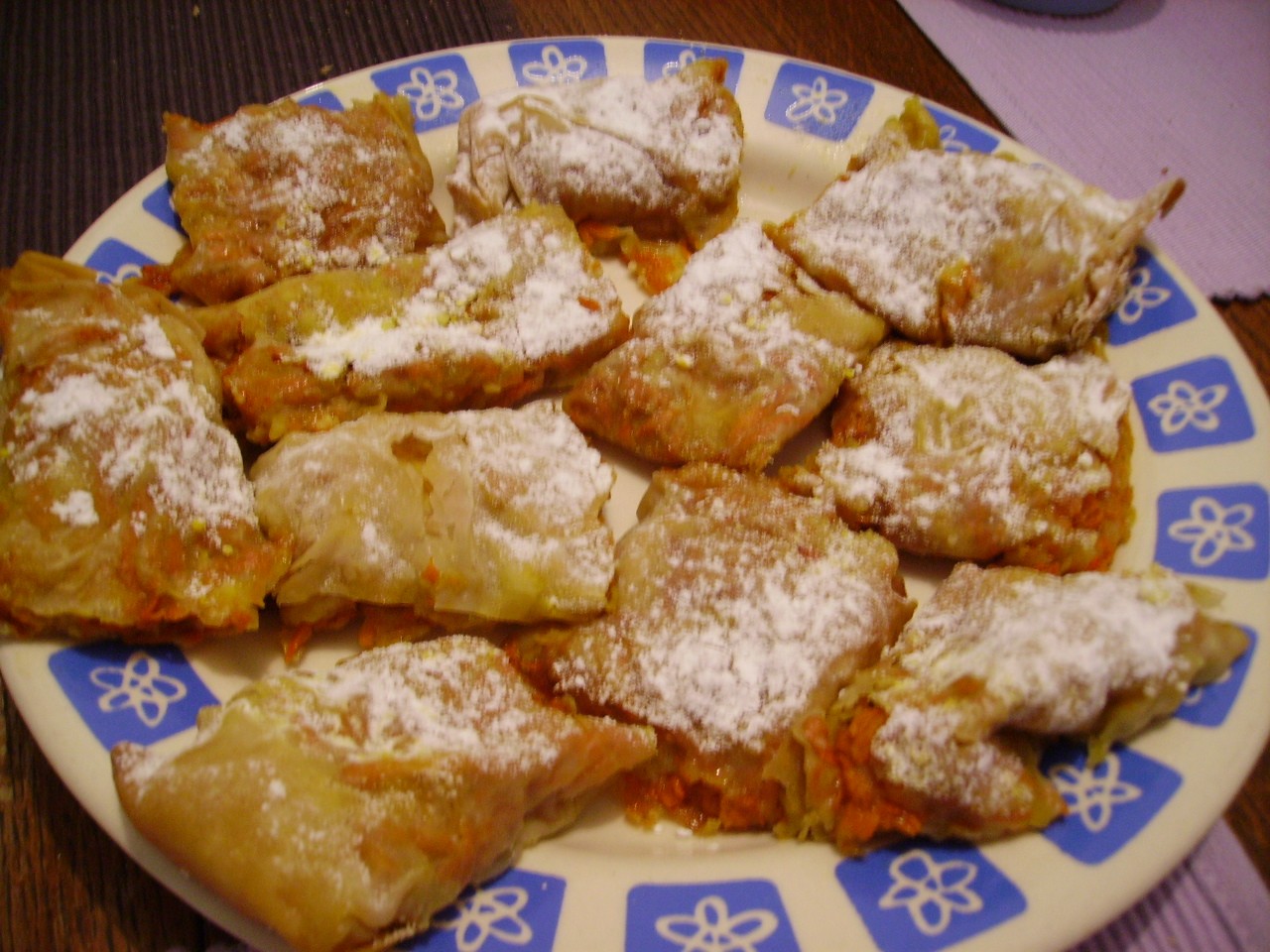
Our last course is pumpkin pastry made with filo dough. In the Netherlands we aren't familiar with pumpkin in sweet dishes, but I love it! Antoanella assures me all these dishes are easy to make, although the aubergine dip does take some time. If you'd like to try, click on these links for the recipes:


Salată de vinete (aubergine dip)
Mămăligă cu Brânză (polenta with cheese)
Ardei umpluţi (stuffed green pepper)

Plăcintă cu dovleac (pumpkin pastry)