Saturday, December 30, 2006

Meal 39. Thai Thom Yum Kung


When I see all the ingredients Bibi has gathered around her to prepare the Thai meal, I am seriously intimidated. I give up ever recreating this meal before she has even started. When she tells me she's planning to open a Thai restaurant, I feel somewhat better...I'm dealing with a professional here.


Like Mike (from my Chinese meal), Bibi is a "European" name, as her Thai name is too long and complicated to pronounce for most Westerners.
Most Thai have a nickname, and even the
kings are not known by their full name! Bibi says:"We just call them King nr. 5 or King nr. 9."

The official name for Bangkok is so long, there's even a special song to help you remember is. Mostly it's just called Krung Thep, which roughly translates into "City of Angels". Anyway, Bibi isn't even from Bangkok!

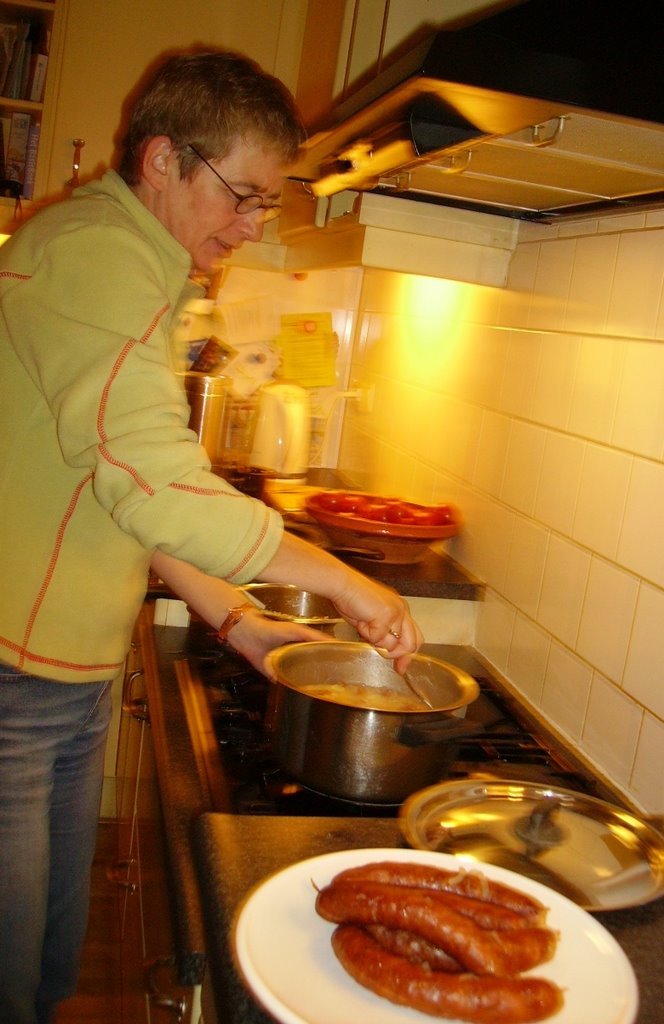
While I'm helping her remove the heads of the big shrimp for our soup, she explains how she needs to be in a good mood while cooking: "I have to be in a good mood for the food to taste good! If I'm in a bad mood, the dishes somehow always turn out too salty or too sweet..."

I'd never heard that before!

As she is cooking for non-Thai, Bibi has been so nice as to adapt the level of hotness to our tastes. She says what we are eating is "children's level". She herself always brings a little box of chili powder whenever she's eating out or at a restaurant. This way, she can surreptitiously add a bit of spice to the dishes that taste very bland to her.

But even within Thai adults there is a variation in what people can stand. Bibi's aunt cooks such spicy food that Bibi's father will not accept dinner invitations to her home anymore!

Our meal starts with little snacks; egg rolls, meat patties and frothy omelet. The omelet is so airy because it's poured into the pan from great heights...Bibi jokes:"We will pour it from the second floor, if we want it to be really light!"

The spicy Thom Yum Kung, brings a nice flush to my cheeks and every spoonful springs a new surprise of mushrooms, coriander or shrimp. Somehow I find it impossible to make good pictures of the food this time. Especially of the main dish, white rice with Beef Curry Matsaman. This is a special recipe, originally only eaten in the King's Palace, according to Bibi. "Every dish has a story in Thailand."

I feel blessed to be able to taste it on this cold rainy winter day in Holland.


As a final lesson, Bibi shows me how to make a spring roll with a napkin (photo at right). I still feel as if I'm in a course about Shakespeare before even learning the alphabet! If she does indeed open a restaurant, I will be the first visitor.


Click here for a simplified recipe for Thom Yum Kung.

Thursday, December 14, 2006

Meal 38. Burkina Faso Chicken Gizzards

Moussa is my host tonight, from Burkina Faso, "the land of good people". As happens more and more often during this project, I have to admit I've never consciously met anybody from this country before. When Moussa hears me speak in French, he exclaims "Ah! It's as if you I'm hearing a Mossi woman speaking! Your accent is exactly the same as the Mossi ethnicity in Burkina!" Somehow the mix of French learnt at school and while travelling in Africa, mixed with Dutch and American accents, led to a similar way of speaking...
I was warned that Moussa is a very good cook, but that he has a penchant for using "organ meat", a first for this project, I must say. So it is no surprise to see what (as a veterinarian, not as a consumer) I recognize as chicken stomachs, also known as gizzards in proper English. They are being marinated in oil, vinegar, onions, garlic and salt.
While I get a complete workshop in how to prepare Burkinese food, Moussa tells me more about his childhood. While he is the oldest son of a large family, he was raised by his great-grandmother, "the woman who has loved me most in life".
"She always gave me everything, we were so attached, that when I slept, she slept. When I awoke, she got up as well!"
But all good things come to an end...in his case, when his great-grandmother died, at the ripe old age of 106. He found it hard to cope without her.
By this time I have not only learnt how to marinate gizzards, but lamb as well. And how to fry plantain, aloko.
I have to say, the gizzards are pretty tasty, and I appreciate their chewiness. The plantains are also good, but not new to me, as the gizzards are and the Lamb with Peanut Sauce. I knew there were countries in Africa where peanutsauce was popular (from a favorite "graphic novel", Aya de Youpogon, which plays in Cote d'Ivoire, Burkina Faso's relatively rich neighbour).
After a surprisingly delicious meal, it's time for tea. This involves a gunpowder tea, mint leaves, a tiny tea kettle and the pouring of tea from great heights, dozens of times! The end result is a very strong "men's tea". It's like a stiff drink, and keeps some people up all night. Moussa tells me, in Burkina Faso the men get excited and call out: "Ataya, ataya!" when the tea is brought out. I can imagine the scene, somehow.


For those who are adventurous and can find gizzards at their local butcher: here is the very simple recipe.

Tuesday, November 28, 2006

Meal 37. French-Canadian Poutine

The way I met David is quite exemplary for the so-called global village. On holiday in Costa Rica, I met a nice Canadian girl and we kept in touch through email. When her high scool friend David came to study in Holland, she let me know. So now I'm here to taste real poutine, a fast food dish I already heard about on the Caribbean coast...
According to David, it's a real blue collar dish and is supposed to be "disgusting, soggy and cholesterol laden", though in a good way. The potatoes should ideally be fried in old oil, so the fries get a brownish colour. I'm not allowed to call it "Quebecois", as the love for poutine is more related to the French-Canadian culture than to the geographic boundaries...I have to admit I used to think the two were the same.
This famous dish is not eaten at fancy restaurants, but at the roadside, at home or at hockey rinks all over Canada. But David wouldn't know about that, he isn't fan of this quintessentially Canadian sport. To quote him literally: "I associate hockey with players on steroids...no skill seems to be involved most of the time! I actually prefer long track skating." Hope he doesn't have any hockey loving friends reading this...

To recreate the orginal poutine, it was impossible to find the right ingredients here: the cheese curds on top are best bought in one specific village, and the gravy used is sold specially as "sauce for poutine". But he has improvised before, while studying in Sweden. This time the cheese is Dutch Gouda, and the gravy is "brown sauce" from Knorr.
You fry the potatoes in (preferably old) oil, shake them with salt in a paper bag to distribute the salt and absorb excess oil. Then pour over gravy and

shredded cheese (curds).
Sounds easy, right?
But I think I'll wait till I'm in Canada to try the real thing, instead of

trying to make it myself here in Holland. It actually reminds me a bit of the Dutch "friet speciaal" or a "patatje oorlog"; the first is fries with mayonaise, ketchup and chopped onions, the

second consists of fries with mayonaise and peanut sauce. In these "dishes", the fries on the bottom always end up a bit soggy too. And I never prepare it at home, I always buy it at the snackbar.

After dinner, we head out to the oldest bar in the Hague with some fellow Canadians and I hear for the first time that Canadians are supposed to say "eh?" at the end of every sentence (and "fuckin'eh" when drunk...not the same as "fucking A", by the way). Somehow I've managed to get to know quite a few Canadians without ever noticing them using "eh"!


Wednesday, November 22, 2006

Meal 36. Slovenian Jota and Štrudel

In many cases, "love" is the reason my hosts end up in the Netherlands. For Breda, from Slovenia, it took the shape of Bert. A real Groninger, he came to Slovenia as a surveyor 30 years ago (a project involving gas pipelines) and brought Breda back home with him. They now have two grown daughters who speak both Dutch and Slovenian. The long trip by car to Slovenia has been made dozens of times, and they now divide their time between a small village in Groningen and Breda's birthplace back home. I am proudly shown photos of their new "summer home" and of the house Breda grew up in.......a centuries old fort with walls almost 2 meters thick! With walls that thick, they just built the toilet in the wall.

Even so, it could be quite cold in the winter. It was Breda's father's job to get the fire started in the morning. To get warm enough for this task, a stiff drink was needed first! This practice was shared by many businessmen, who would start the day with a nice coffee and cognac at the local café.

The hearty meal Breda is serving tonight is also meant for cold winter nights. We start off with roasted chestnuts from a tree they've planted themselves in the garden. The main dish, Jota, is traditionally served in mountain huts after a long day's work. It consists of some kind of pickled turnip -Kisla Repa-, sausage (both specially brought over from Slovenia), potatoes, brown beans and lard with bacon. Breda's oldest daughter was vegetarian for a long time, but would make an exception for the bacon bits!
Breda's son-in-law, Erik, tells a story about less delicious food. When he helped out at a farm a couple of years back, the vegetables they got for lunch were from jars of preserves from the cellar. They seemed quite old, and the farmer's widow they worked for would scrape off the layer of mold on top before serving the contents. After she died, it turned out there were preserves in the cellar from before World War II!
The positive side is that you can eat 60 year old food without even becoming sick. But Erik says he never really enjoyed those lunches...
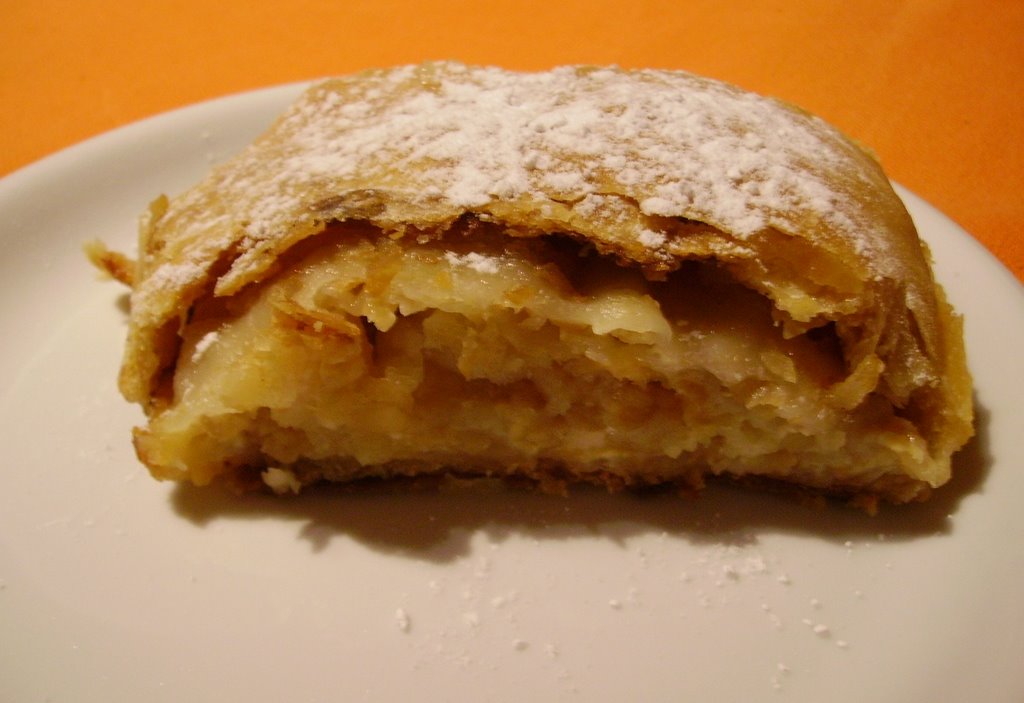
The high point of this meal is the apple strudel for dessert. I enjoy watching the preparations almost as much as eating the hot delicacy, sprinkled with powdered sugar. Nowadays, Breda only makes this apple pastry about twice a year, so it is really a special occasion. Although it isn't difficult to make, it does require several steps and a big table, so I don't see myself doing it anytime soon in my cramped student quarters.
After strudel with cappuccino (Slovenia is close to Italy, after all), I receive a Slovenian going away present made by Breda's sister. It's a jar of plum preserves smelling very strongly of rum. I've tried it already and it's great with custard.
Although Breda loves good food, miraculously she still fits in her 30 year old wedding dress and the stylish velvet jacket she is wearing to a party after dinner. Breda and Bert drop me off at the train station on the way to the party and I am left in the cold with a warm feeling inside, contemplating how generous and hospitable people can be to previously unknown guests like me...


If you have the time, a big table and an old table cloth, you can try Breda's Štrudel recipe at home.

Saturday, November 11, 2006

Meal 35. Lithuanian Barščiai and Potatoes with Dill

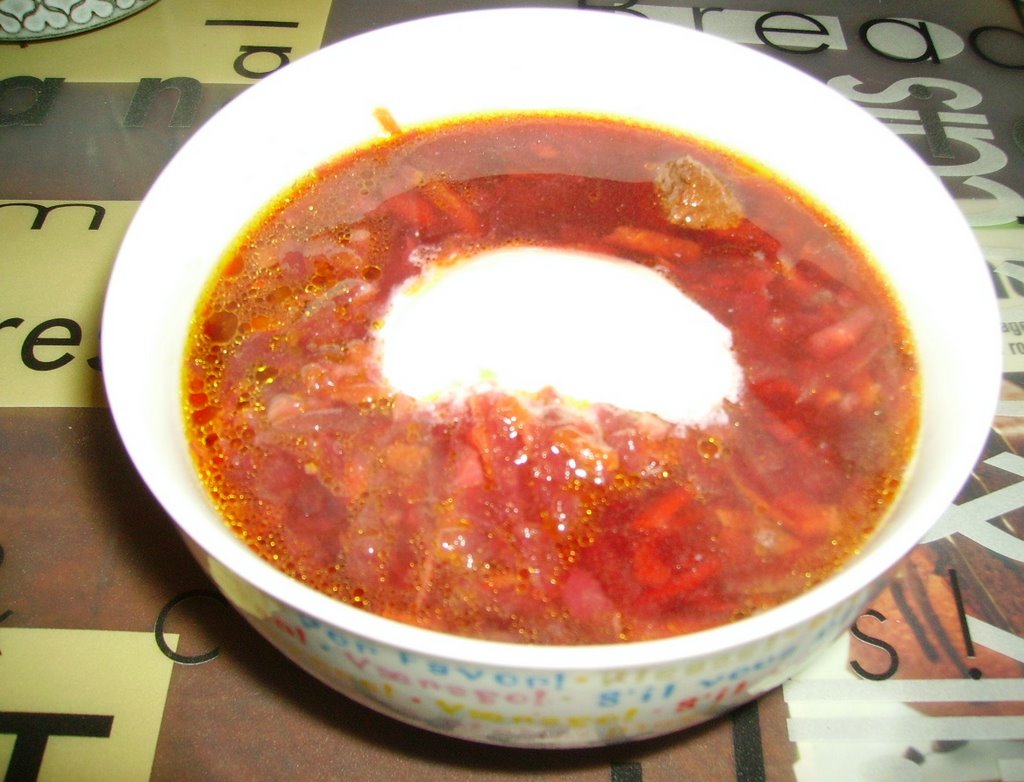
It's the first time I eat barščiai for this project, but not the first time I eat "borsht", an easier way to spell it in English. As you can see in meal 11, where it al revolves around my father's beetsoup.
Gintare (which means "amber" in Lithuanian) is preparing the soup as her grandmother always did it. This recently graduated sociologist does agree the barščiai she is making is similar to many other beetsoups around the world, though for example in Belarus they would add cabbage.
Secretly I am glad we are not eating another local specialty, smoked pig's ear, which is served as a snack with beer. While Gintare is preparing the potatoes, we sip on tea and gobble up some yummy chocolates she brought from home. She's only really lived in the Netherlands for a short time, but sometimes feels frustrated by the language and the bureaucratic procedures. Recently she was called by a girl, who had found Gintare's name through some list of expat Lithuanians. She called and explained her situation, and Gintare commiserated :"Oh yes, I know how you feel...", but then found out while she had only lived here for 2 months, this girl had lived here for over 3 years!

There aren't that many compatriots in Groningen, though she will also feel immediate bonding with Latvians, who speak almost the same (Baltic) language and have a similar culture.
I ask:"What about Estonians?", also a Baltic state, after all.
"Oh no! They are much more similar to the Finnish...a bit more reserved as well."
Well, that's good to know. I wouldn't be surprised if the Dutch were compared to the Flemish, but I would if they were deemed similar to the Germans.
I will ask the Latvian girl who will be cooking for me in December what her opinion is on the matter...
Vilnius (Lithuania) and Riga (Latvia) are now part of Europe and sadly, both are becoming popular destinations for Brittish "stag parties", involving drunk young lads looking for a cheap alcohol and pretty girls. They don't show too much appreciation for its beautiful baroque city centre.
I hope an advantage of joining the EU is an improvement in dental care. Gintare tells me a story about barbaric practices during her childhood including drilling in teeth without painkillers. She was so scared of the dentist she didn't go for seven whole years. At the end of this period, two weeks of dental work were needed to repair the damage!
The soup is delicious, by the way...Gintare's grandmother would be proud.


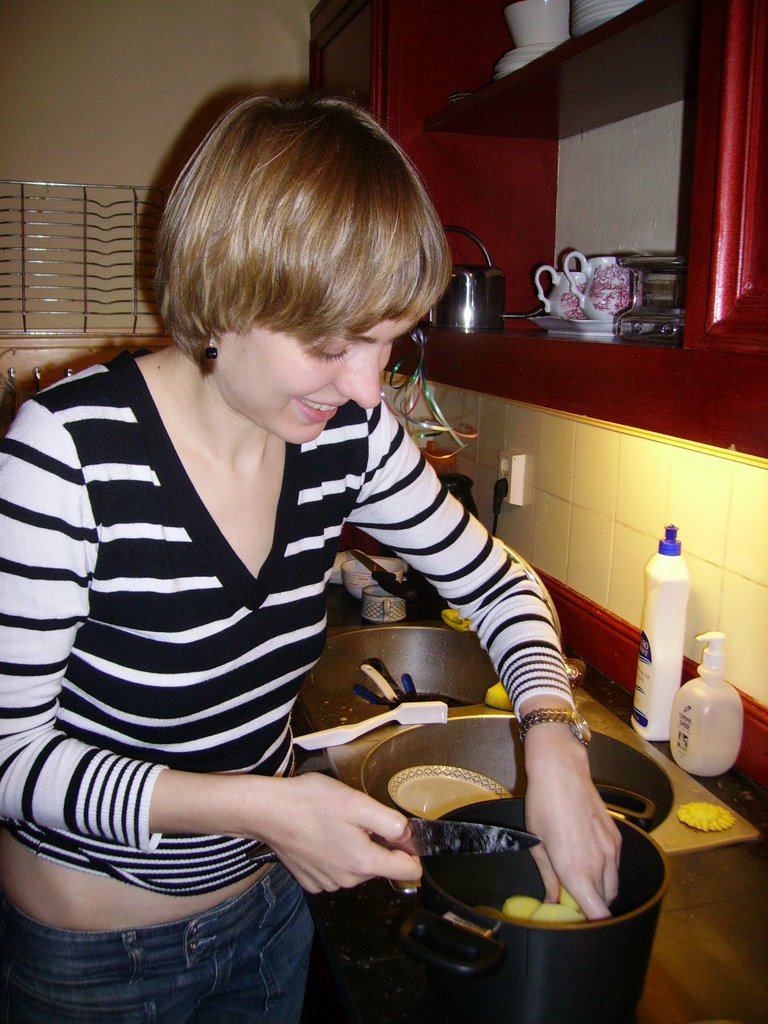
The potatoes fried in butter with dill are served on the side and are such an easy and effective side dish, I promise myself to make it one day soon. I have to admit, for the borsht/barščiai I will use my own grandmother's recipe!

For those without these loyalty issues, try the Lithuanian version.