Friday, January 26, 2007

Meal 41. Latvian Rosols

Nanda has invited over Digne, a friend who lives in the Hague as well. They met up through a Latvian "Myspace" type website. Digne was checking out the profiles and..."Hey! There are more Latvians here in the Hague!" So now she is here, the official inspector of Rosols, the special potato salad served on birthdays, holidays and all other special occasions. It's a festive dish, but "even boys know how to make it!" Nanda's father often makes it for her when she's back in Riga for a visit. The last couple of years she's lived in France (to study sound engineering) and here in Holland (to study ArtScience).

While we're chopping and dicing the sausage, carrots, gherkins, eggs and potatoes, Nanda tells me lots about Latvia. Russia plays a big part in its recent history, they occupied Latvia till 1990. Till then, all "official" things, like shop fronts or tram tickets, were in Russian. After independence, everything was written in Latvian, but on some facades, the bleached out shadows of the Russian letters are still visible. There's quite a polemic going on now about the language, as the big Russian minority (almost a third of the population) want Russian to become the offical second language of the nation. Nanda was even affected by this struggle personally...when she worked at the ministry of education there was a bomb scare in the building . All because they wanted to change education so that all lessons would be taught in Latvian.
Nanda tells me sometimes at the mark
et she will be speaking to the vendors in Latvian and they will answer in Russian. A bilingual dialogue... The salad progresses and Digne inspects the proportions of the different ingredients. The pieces have to be chopped very finely, as “only grandma’s make rosols with big chunks!” Then generous amounts of sour cream and mayonnaise are added. The aspect mostly reminds me of potato salads I have had in the past at barbecues or parties. But here in Holland it doesn’t have a special name or significance…and often it’s bought at the supermarket and not made at home. Which does make a big difference, as I notice when I take my first bite. The rosols isn’t really photogenic, but it is delicious comfort food and I can imagine it being seen as a “festive” dish.

After dinner we enjoy a cup of lindenflower tea, with lindenflower honey to sweeten it, also typical for grandmothers according to Nanda and Digne. To accompany it, some rock hard caramels that need an unexpected amount of violence to separate them from their friends. Here at right you see Nanda holding a Latvian souvenir…it’s a bread that’s a couple of months old, but she doesn’t want to throw it away just yet. Amazingly, this “real” bread just turns hard and doesn’t get moldy.

Click here for the original Rosols recipe. It's easy to make!


Thursday, January 04, 2007

Meal 40. Costa Rican Gallo Pinto

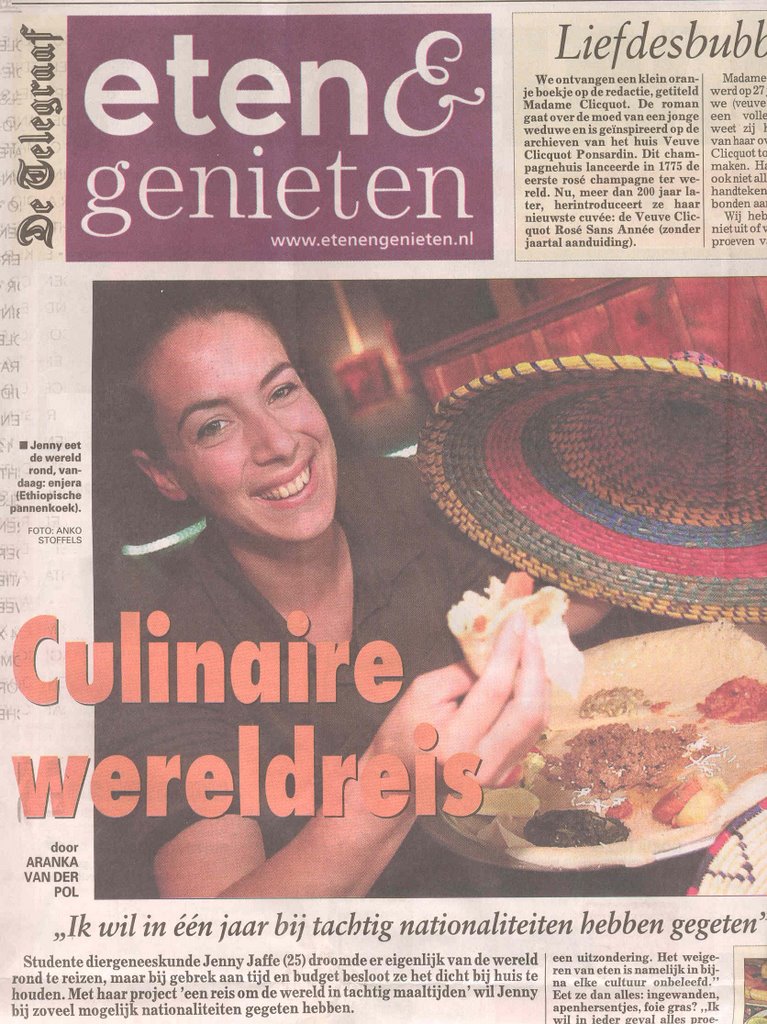
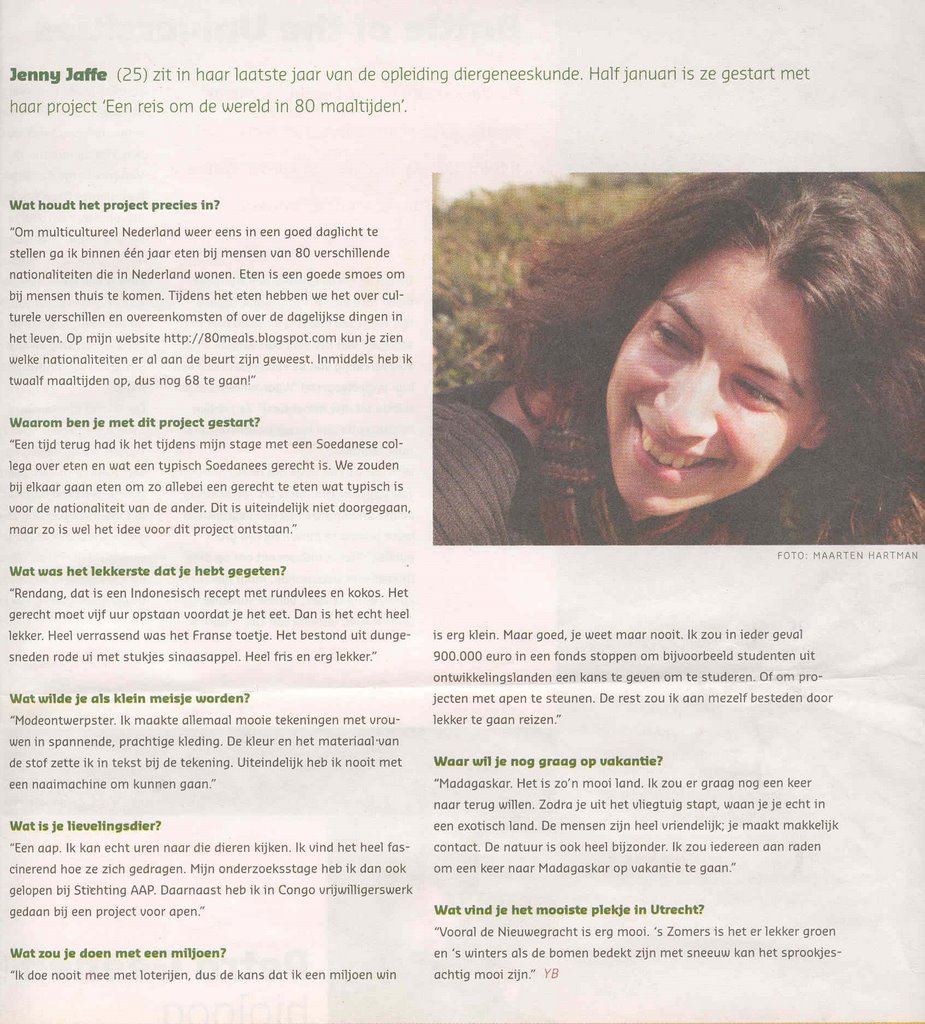
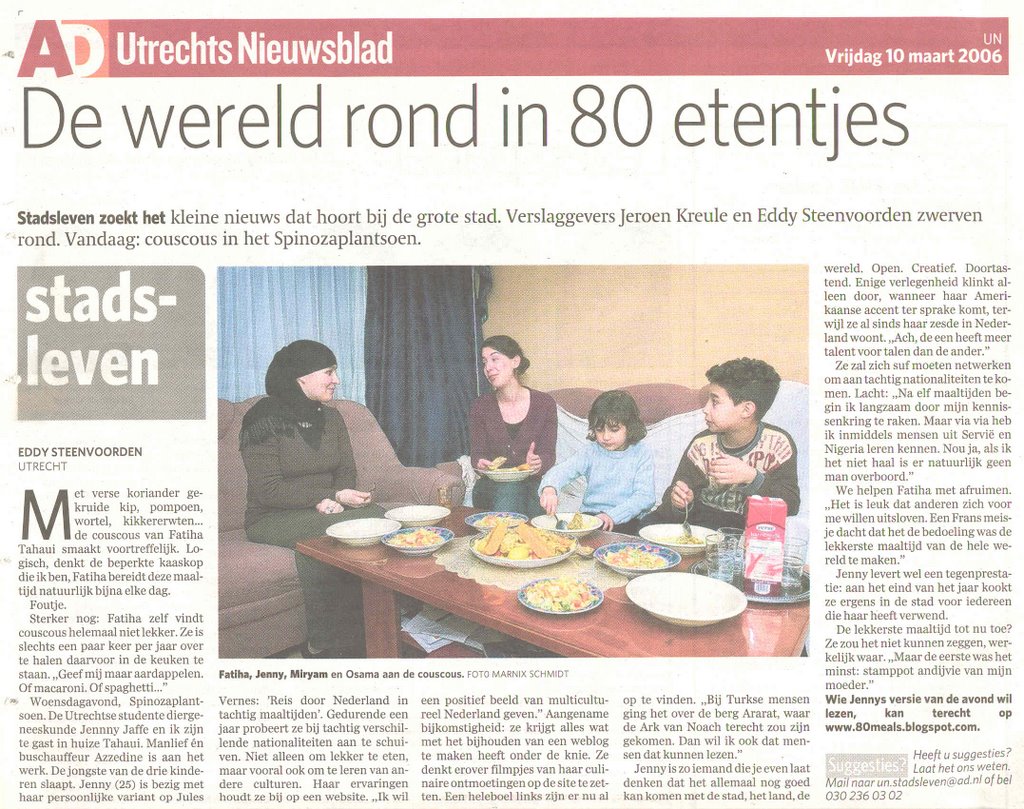
This meal is special....firstly because it is the 4oth meal and thus is the half-way mark of my trip. Secondly because it is Costa Rican, and the food brings back memories of my exchange year in that Central-American country seven years ago. It's great to laugh and chat again with people who have been to the same places and speak Spanish the Costa Rican way. Saying vos instead of tu will sound ridiculous in almost any other country.

Fresia is a Ph.D. student of Physics here in the Netherlands, and her friend Marcela as well, but in Brazil. They have invited Carlos as well, and even though he is Colombian, he is in charge of the patacones...the twice-fried plantains both countries have in common (see Meal 20. Colombian Bandeja Paisa).
A truly unique part of Costa Rican cuisine, though, is the world famous Salsa Lizano (at right) that Fresia specially brought from back home to give her food that typical flavour. The weird thing is that when I look at the bottle a bit closer, the Lizano company turns out to be owned by Unilever, a British-Dutch food (and cleaning products) conglomerate. That's globalization for you!
Fresia has a whole collection of tico (=Costa Rican) food and condiments, but the locally famous spirit guaro isn't included. "I'm afraid of giving my country a bad name if I let people here drink that!", she admits.
Serving the very popular ceviche is a better tactic. This delicious and refreshing dish made of raw fish, onions, lemon juice and cilantro (coriander leaves) is easy to make and often served for lunch.

But more "typically tico" is the rice and beans called gallo pinto. It's supposedly name after the "painted rooster" whose black and white feathers are similar to the colours of this dish. During my year in Costa Rica I must have had this about 365 times...it can be served for breakfast, lunch or dinner! Cilantro, fried onions and garlic and Salsa Lizano give it a typical taste, and the chopped bell peppers are added for a touch of colour.
Marcela remembers how her mother made rice attractive for her kids by adding peas, grated carrots or bell pepper.
As we eat, we listen to traditional songs that were always played at Fresia's dance classes. Though in the discos you will mostly hear salsa, merengue with some pop and reggae thrown in, quite a lot of young Costa Ricans have learnt folk dancing at school or university.
I mention how I was surprised that my host family hadn't learned to spell my name correctly after living with them for half a year (Yeny instead of Jenny). Later I noticed many Costa Ricans don't care about the spelling of their own name. One day it's Mainor, the other day Minor. And you wouldn't believe the quantity of boys named Jhonny!
Fresia laughs:"You wouldn't think so, but my name has been spelled in I don't know how many different ways! Fressia, Frezia, Frecia..."
What is also different, is the fact that many people (mostly younger males) are always referred to by some strange nickname. El Muerto (the Dead Guy) for an unusually pale friend, Watchi for someone who looked like a local watchman, Chile for a guy who was from there originally, etc. On my last trip I was presented to a Repollo (Cabbage)...his backpack bore the slogan: "Say no to violence against vegetables!"


If you'd like to try your hand at ceviche, here's the recipe.

Saturday, December 30, 2006

Meal 39. Thai Thom Yum Kung


When I see all the ingredients Bibi has gathered around her to prepare the Thai meal, I am seriously intimidated. I give up ever recreating this meal before she has even started. When she tells me she's planning to open a Thai restaurant, I feel somewhat better...I'm dealing with a professional here.


Like Mike (from my Chinese meal), Bibi is a "European" name, as her Thai name is too long and complicated to pronounce for most Westerners.
Most Thai have a nickname, and even the
kings are not known by their full name! Bibi says:"We just call them King nr. 5 or King nr. 9."

The official name for Bangkok is so long, there's even a special song to help you remember is. Mostly it's just called Krung Thep, which roughly translates into "City of Angels". Anyway, Bibi isn't even from Bangkok!

While I'm helping her remove the heads of the big shrimp for our soup, she explains how she needs to be in a good mood while cooking: "I have to be in a good mood for the food to taste good! If I'm in a bad mood, the dishes somehow always turn out too salty or too sweet..."

I'd never heard that before!

As she is cooking for non-Thai, Bibi has been so nice as to adapt the level of hotness to our tastes. She says what we are eating is "children's level". She herself always brings a little box of chili powder whenever she's eating out or at a restaurant. This way, she can surreptitiously add a bit of spice to the dishes that taste very bland to her.

But even within Thai adults there is a variation in what people can stand. Bibi's aunt cooks such spicy food that Bibi's father will not accept dinner invitations to her home anymore!

Our meal starts with little snacks; egg rolls, meat patties and frothy omelet. The omelet is so airy because it's poured into the pan from great heights...Bibi jokes:"We will pour it from the second floor, if we want it to be really light!"

The spicy Thom Yum Kung, brings a nice flush to my cheeks and every spoonful springs a new surprise of mushrooms, coriander or shrimp. Somehow I find it impossible to make good pictures of the food this time. Especially of the main dish, white rice with Beef Curry Matsaman. This is a special recipe, originally only eaten in the King's Palace, according to Bibi. "Every dish has a story in Thailand."

I feel blessed to be able to taste it on this cold rainy winter day in Holland.


As a final lesson, Bibi shows me how to make a spring roll with a napkin (photo at right). I still feel as if I'm in a course about Shakespeare before even learning the alphabet! If she does indeed open a restaurant, I will be the first visitor.


Click here for a simplified recipe for Thom Yum Kung.

Thursday, December 14, 2006

Meal 38. Burkina Faso Chicken Gizzards

Moussa is my host tonight, from Burkina Faso, "the land of good people". As happens more and more often during this project, I have to admit I've never consciously met anybody from this country before. When Moussa hears me speak in French, he exclaims "Ah! It's as if you I'm hearing a Mossi woman speaking! Your accent is exactly the same as the Mossi ethnicity in Burkina!" Somehow the mix of French learnt at school and while travelling in Africa, mixed with Dutch and American accents, led to a similar way of speaking...
I was warned that Moussa is a very good cook, but that he has a penchant for using "organ meat", a first for this project, I must say. So it is no surprise to see what (as a veterinarian, not as a consumer) I recognize as chicken stomachs, also known as gizzards in proper English. They are being marinated in oil, vinegar, onions, garlic and salt.
While I get a complete workshop in how to prepare Burkinese food, Moussa tells me more about his childhood. While he is the oldest son of a large family, he was raised by his great-grandmother, "the woman who has loved me most in life".
"She always gave me everything, we were so attached, that when I slept, she slept. When I awoke, she got up as well!"
But all good things come to an end...in his case, when his great-grandmother died, at the ripe old age of 106. He found it hard to cope without her.
By this time I have not only learnt how to marinate gizzards, but lamb as well. And how to fry plantain, aloko.
I have to say, the gizzards are pretty tasty, and I appreciate their chewiness. The plantains are also good, but not new to me, as the gizzards are and the Lamb with Peanut Sauce. I knew there were countries in Africa where peanutsauce was popular (from a favorite "graphic novel", Aya de Youpogon, which plays in Cote d'Ivoire, Burkina Faso's relatively rich neighbour).
After a surprisingly delicious meal, it's time for tea. This involves a gunpowder tea, mint leaves, a tiny tea kettle and the pouring of tea from great heights, dozens of times! The end result is a very strong "men's tea". It's like a stiff drink, and keeps some people up all night. Moussa tells me, in Burkina Faso the men get excited and call out: "Ataya, ataya!" when the tea is brought out. I can imagine the scene, somehow.


For those who are adventurous and can find gizzards at their local butcher: here is the very simple recipe.

Tuesday, November 28, 2006

Meal 37. French-Canadian Poutine

The way I met David is quite exemplary for the so-called global village. On holiday in Costa Rica, I met a nice Canadian girl and we kept in touch through email. When her high scool friend David came to study in Holland, she let me know. So now I'm here to taste real poutine, a fast food dish I already heard about on the Caribbean coast...
According to David, it's a real blue collar dish and is supposed to be "disgusting, soggy and cholesterol laden", though in a good way. The potatoes should ideally be fried in old oil, so the fries get a brownish colour. I'm not allowed to call it "Quebecois", as the love for poutine is more related to the French-Canadian culture than to the geographic boundaries...I have to admit I used to think the two were the same.
This famous dish is not eaten at fancy restaurants, but at the roadside, at home or at hockey rinks all over Canada. But David wouldn't know about that, he isn't fan of this quintessentially Canadian sport. To quote him literally: "I associate hockey with players on steroids...no skill seems to be involved most of the time! I actually prefer long track skating." Hope he doesn't have any hockey loving friends reading this...

To recreate the orginal poutine, it was impossible to find the right ingredients here: the cheese curds on top are best bought in one specific village, and the gravy used is sold specially as "sauce for poutine". But he has improvised before, while studying in Sweden. This time the cheese is Dutch Gouda, and the gravy is "brown sauce" from Knorr.
You fry the potatoes in (preferably old) oil, shake them with salt in a paper bag to distribute the salt and absorb excess oil. Then pour over gravy and

shredded cheese (curds).
Sounds easy, right?
But I think I'll wait till I'm in Canada to try the real thing, instead of

trying to make it myself here in Holland. It actually reminds me a bit of the Dutch "friet speciaal" or a "patatje oorlog"; the first is fries with mayonaise, ketchup and chopped onions, the

second consists of fries with mayonaise and peanut sauce. In these "dishes", the fries on the bottom always end up a bit soggy too. And I never prepare it at home, I always buy it at the snackbar.

After dinner, we head out to the oldest bar in the Hague with some fellow Canadians and I hear for the first time that Canadians are supposed to say "eh?" at the end of every sentence (and "fuckin'eh" when drunk...not the same as "fucking A", by the way). Somehow I've managed to get to know quite a few Canadians without ever noticing them using "eh"!